

For anyone who has spent entirely too much time wrestling with an artificial intelligence to get a decent picture, the biggest hurdle is almost always the prompt. Trying to coax a model into generating something that actually feels relevant to your real life usually requires writing paragraphs of painfully specific text and constantly uploading manual reference photos. Google is officially streamlining that entire process. By integrating its context-aware Personal Intelligence system directly with its latest Nano Banana 2 imaging model, Gemini can now generate highly personalised images with barely any prompting required.
Pulling from Your Digital Life
The core of this update is deep ecosystem integration. Instead of forcing you to explicitly explain your specific aesthetic or describe exactly what your dog looks like, Gemini can now securely pull that context directly from your connected Google services. If you opt into the feature and link your Google Photos library, the AI utilises your existing facial recognition labels and structured memories to understand who and what matters most to you.
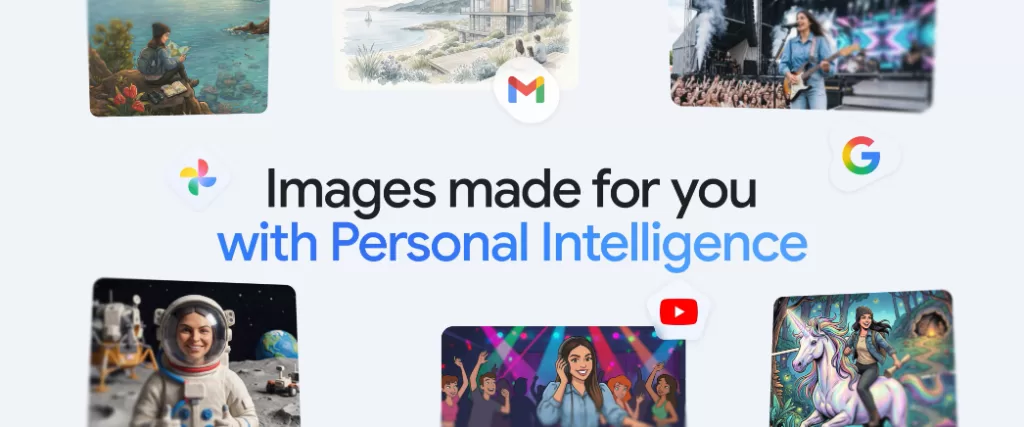
This completely changes the creative workflow. You can simply type a short prompt like “create a claymation image of my family enjoying our favourite weekend activity,” and Gemini handles the heavy lifting. It actively cross-references your digital history to figure out who your family members are, what you typically do on a Saturday, and generates an accurate, stylised image without requiring a single uploaded reference file. Similarly, a vague prompt like “design my dream house” will return architectural concepts heavily influenced by your actual, established tastes rather than generic stock imagery.
Maintaining Control and Privacy
Naturally, handing an AI direct access to your personal photo gallery raises some immediate red flags. Google is addressing these privacy concerns by making the entire Personal Intelligence connection strictly opt-in. Furthermore, the company explicitly guarantees that your private Google Photos library is not being scraped to directly train its broader foundational language and image models.
Recognising that the AI will occasionally misinterpret your digital history, Google has also built in several native refinement tools. If the initially generated image feels slightly off, you can use a dedicated icon to manually swap in a different reference photo from your library to guide the system. There is also a highly transparent “Sources” button that clearly reveals exactly which personal images and data points Gemini used to construct its final output, ensuring you are never left guessing how the AI arrived at its conclusion.
Currently, this hyper-personalised image generation is rolling out gradually to users subscribed to Google’s premium AI tiers—specifically the Plus, Pro, and Ultra plans—across the United States. While broader regional availability is scheduled for later this year, this update signals a massive shift toward AI tools that actually understand the user sitting behind the keyboard.