


The artificial intelligence race has mostly been defined by tech giants chasing the next massive leap in raw capability. However, Anthropic’s latest flagship release, Claude Opus 4.7, takes a slightly different approach. While the company openly admits it intentionally held back its absolute most powerful “Mythos” model from the public due to safety concerns, Opus 4.7 represents a highly refined, aggressively capable upgrade for everyday professionals and developers. It is built to be more autonomous, significantly better at following literal instructions, and is equipped with a vastly improved visual engine.

The Developer’s Dream
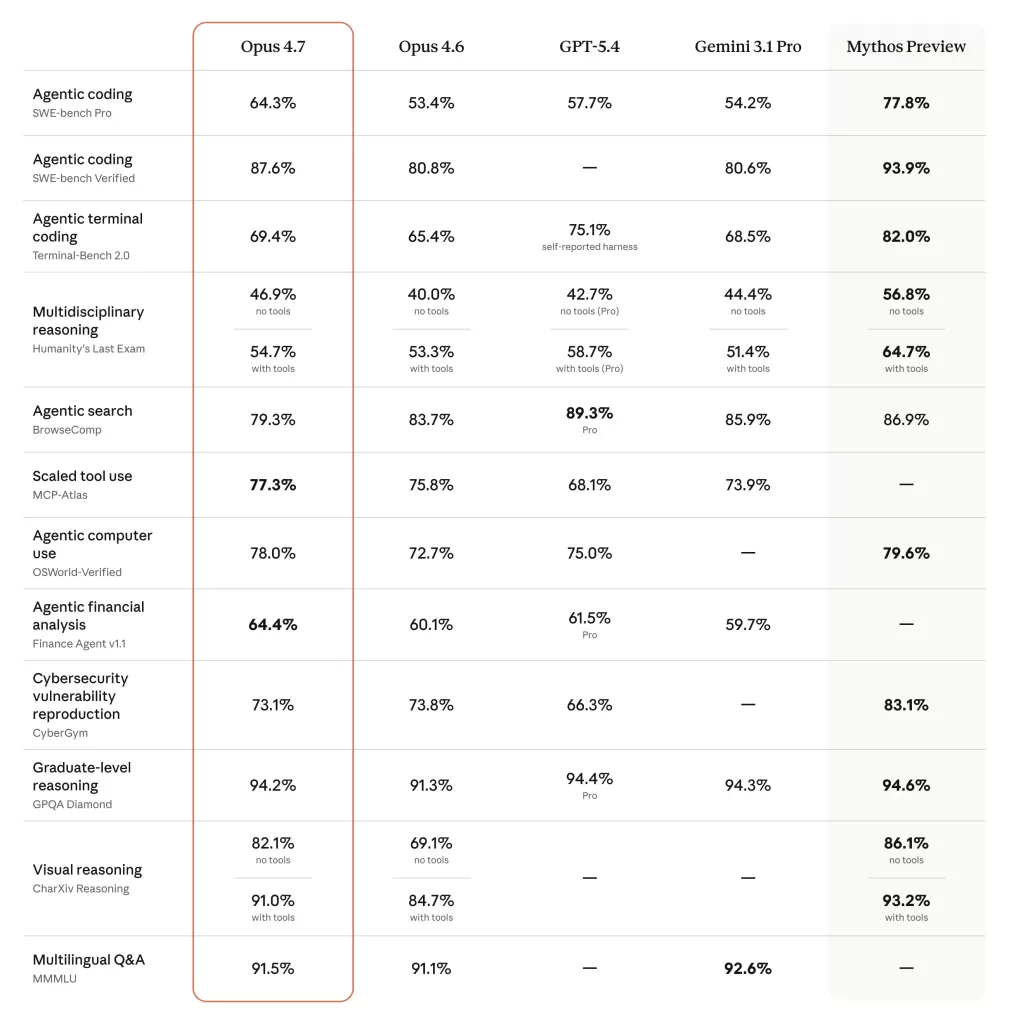
Where Opus 4.7 truly flexes its muscle is in software engineering. For a long time, using artificial intelligence for coding meant sitting at your desk and constantly supervising the output, fixing hallucinated variables, and holding the model’s hand through multi-file changes. Anthropic claims to have effectively severed that leash. The new model is explicitly engineered to handle complex, long-running programming tasks with remarkable consistency.
It does not just blindly write code and hope for the best; it actively devises ways to verify its own outputs before reporting back to the user. This autonomy is heavily driven by a new background feature called Auto Mode. Developers can assign a massive task in their terminal or browser, and Claude will independently navigate permissions, read local directories, and make structural decisions until the entire job is completed. It essentially acts less like a standard autocomplete tool and more like a dedicated, reliable junior engineer.
High-Resolution Vision and Professional Taste
The upgrades extend far beyond the command line. Anthropic has tripled the visual processing capabilities of the model. Opus 4.7 can now safely ingest and analyse high-resolution images up to 2,576 pixels on the long edge. In practical terms, this means you can feed the AI incredibly dense screenshots, complex circuit schematics, or tightly packed financial documents, and it will accurately read tiny text that previous versions would have completely blurred out.
Anthropic is also leaning heavily into the concept of professional “taste.” Instead of just generating technically correct but incredibly dry text, Opus 4.7 is tuned to be a much better office worker. Whether you are asking it to design a user interface, draft a complex legal contract, or build out a corporate slide deck, the model is designed to produce results that actually look and sound highly professional right out of the gate. In internal testing, it even scored at the absolute top of its class as a rigorous financial analyst.
Literal Instructions and The Token Trade-Off
If you have spent the last year learning how to properly prompt an AI, you might have to unlearn a few habits. Previous models often tried to guess your underlying intent, filling in the blanks if your instructions were slightly vague. Opus 4.7 takes things completely literally. It follows instructions exactly as written. While this drastically reduces the chances of the AI going off on a weird creative tangent, it means users will need to be incredibly precise with their commands.
To achieve this level of precision, Anthropic had to fundamentally change how the model reads text. The new tokeniser actually breaks words down into smaller pieces than before. This forces the AI to pay closer attention, but there is a catch: the same prompt will now use roughly up to 35% more tokens compared to Opus 4.6. To help manage these backend costs, Anthropic is introducing a highly practical feature called Task Budgets. Before sending the AI off to fix a massive codebase, you can explicitly tell it to stop working once it hits a specific token limit, ensuring you never wake up to an astronomical API bill. There is also a new Extra High effort setting that gives users much finer control over exactly how much the model thinks before it responds.
Pricing & Availability
Despite the backend structural changes, the sticker price for accessing the model remains exactly the same. Developers utilising the Claude API will still pay $5 (RM23.90) per million input tokens and $25 (RM119.50) per million output tokens. However, due to the new tokeniser using more data per prompt, heavy users will likely notice their usage quotas burning down slightly faster than before.
If you want to test out the upgraded model, you will not have to wait. Claude Opus 4.7 is officially rolling out today across the entire Anthropic ecosystem, including the main web interface and the dedicated mobile applications. For enterprise developers, the model is also immediately available through major cloud partners, including Amazon Bedrock, Google Cloud’s Vertex AI, and Microsoft Foundry.