

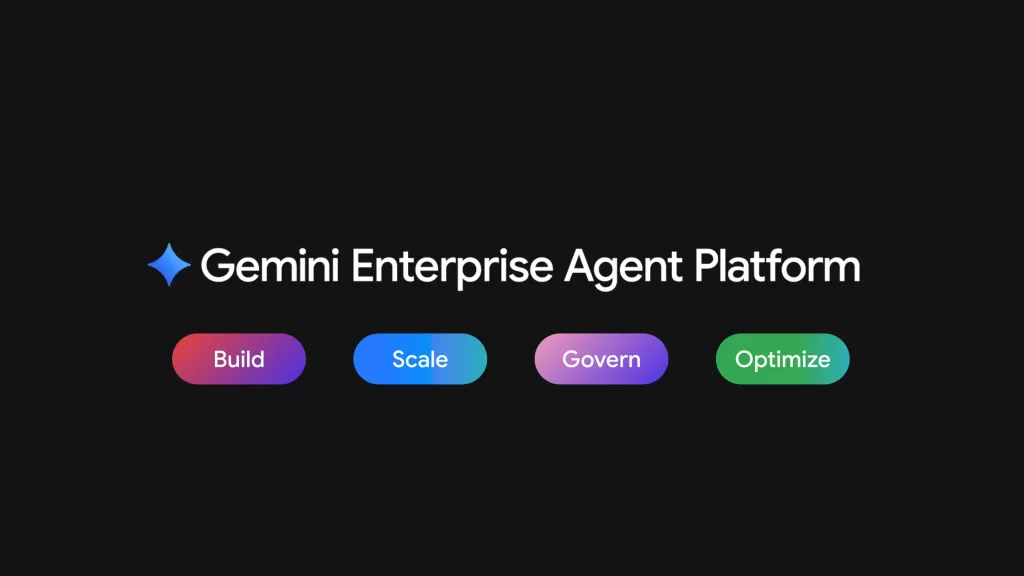
For the last few years, enterprise artificial intelligence has primarily focused on chatbots answering questions or summarising text. However, as the industry rapidly shifts toward autonomous digital agents capable of executing complex workflows, developers are realising that standard tools are no longer sufficient. To cater to this shift, Google has officially announced the Gemini Enterprise Agent Platform at Google Cloud Next. Serving as the direct evolution of the popular Vertex AI suite, this new platform provides technical teams with a comprehensive, single destination to build, scale, govern, and optimise enterprise-grade AI agents.
The core philosophy behind the new platform is providing flexibility for entirely different development styles. For teams that prefer a visual, low-code approach, Google introduced Agent Studio. This environment allows developers to seamlessly move from drafting simple textual prompts to deploying complex workflows without getting bogged down in heavy scripting. However, when deep customisation is required, users can export their logic directly into the upgraded Agent Development Kit. This full-code environment utilises a brand-new graph-based framework, enabling software engineers to organise massive networks of highly specialised sub-agents that work together to solve complex, multi-step problems. To power these digital workers, the platform integrates natively with Model Garden, giving developers immediate, first-class access to over two hundred of the world’s leading foundational models, including Google’s latest Gemini 3.1 Pro, Lyria 3, and the open-source Gemma 4.
Building a smart agent is one thing, but keeping it running effectively in a massive corporate environment is a completely different technical challenge. Google has completely re-engineered its backend architecture to handle this load, introducing a revamped Agent Runtime that promises sub-second cold starts and the ability to provision new agents in mere seconds. More importantly, this new runtime officially supports multi-day workflows. Instead of an agent shutting down when a user closes their browser, developers can now deploy long-running agents that operate autonomously for days at a time to manage deep reasoning tasks. To ensure these agents do not lose the plot over long periods, Google integrated a new Memory Bank feature. This grants the agents persistent, long-term context, allowing them to proactively recall a user’s past actions and preferences across entirely different computing sessions without needing constant manual reminders.
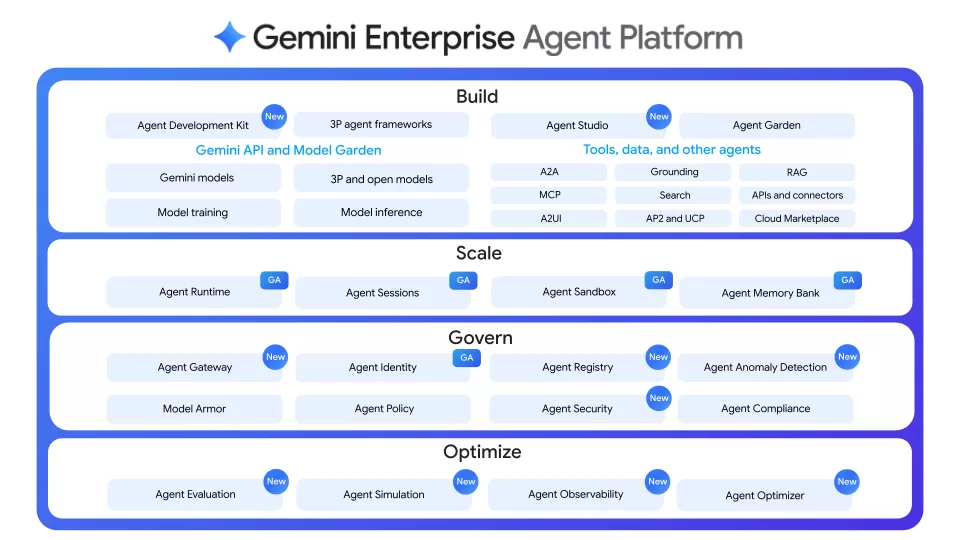
Releasing a fleet of autonomous software agents into a corporate network naturally raises severe security and compliance concerns for IT administrators. To prevent digital sprawl and maintain strict oversight, the platform establishes centralised control mechanisms from the ground up. The most critical addition is Agent Identity, which assigns every single deployed agent a verifiable, unique cryptographic identifier. This ensures that every action an agent takes leaves a clear, highly auditable trail that maps directly back to the company’s defined authorisation policies.
Furthermore, Google introduced the Agent Gateway, which acts as a centralised air traffic control system for your entire AI ecosystem. This gateway manages all connectivity between your agents and internal corporate tools, aggressively enforcing security policies while utilising Model Armor protections to safeguard against malicious prompt injections and sensitive data leaks. To keep everything organised, a new Agent Registry serves as a single source of truth, indexing every approved internal tool and skill so employees only interact with strictly governed assets.
Finally, to ensure these agents are actually hitting their designated targets rather than just confidently hallucinating, Google rolled out a suite of optimisation tools. Developers can utilise Agent Simulation and Agent Evaluation to rigorously test their digital workers against complex scenarios before pushing them into a live production environment. Once live, Agent Observability provides full execution traces and a real-time window into the agent’s underlying reasoning, making it incredibly easy to debug issues on the fly.
The Gemini Enterprise Agent Platform represents a massive step forward for corporate AI development. It combines world-class foundational models with robust development kits and rigid, enterprise-grade security guardrails. Google is actively helping businesses move past the experimental phase and start deploying autonomous agents that deliver genuine, production-scale impact.