

Everyone is talking about artificial intelligence right now, but there is a massive difference between knowing how to prompt a chatbot and actually building production-ready AI software. To bridge this critical skills gap, Amazon Web Services (AWS) and IT managed services provider Elitery have officially expanded their CendekiAwan Malaysia program in partnership with the Asia Pacific University of Technology and Innovation. Since its inception in 2025, the overarching initiative has successfully upskilled over fifteen thousand Malaysian students. Now, the latest 2026 chapter is pushing 2,500 students at the Asia Pacific University (APU), with both technical and non-technical backgrounds, through an intensive, three-month generative AI development pipeline.
The new phase at APU provides a new structured pathway for the students to advance from basic concepts directly to deployable code. The pathway starts with participants learning foundational generative AI principles and building working software prototypes using AWS’s gamified app-building tool, PartyRock. However, students who demonstrated strong early prototyping skills were advanced to a much more rigorous second phase. Here, they were handed access to Amazon Bedrock, a managed service offering powerful foundational models, and Kiro, an AI-powered coding assistant. Instead of just tinkering with basic ideas, students used everyday language to direct Kiro to automatically generate the complex code, documentation, and tests required to bring fully functional software to life.
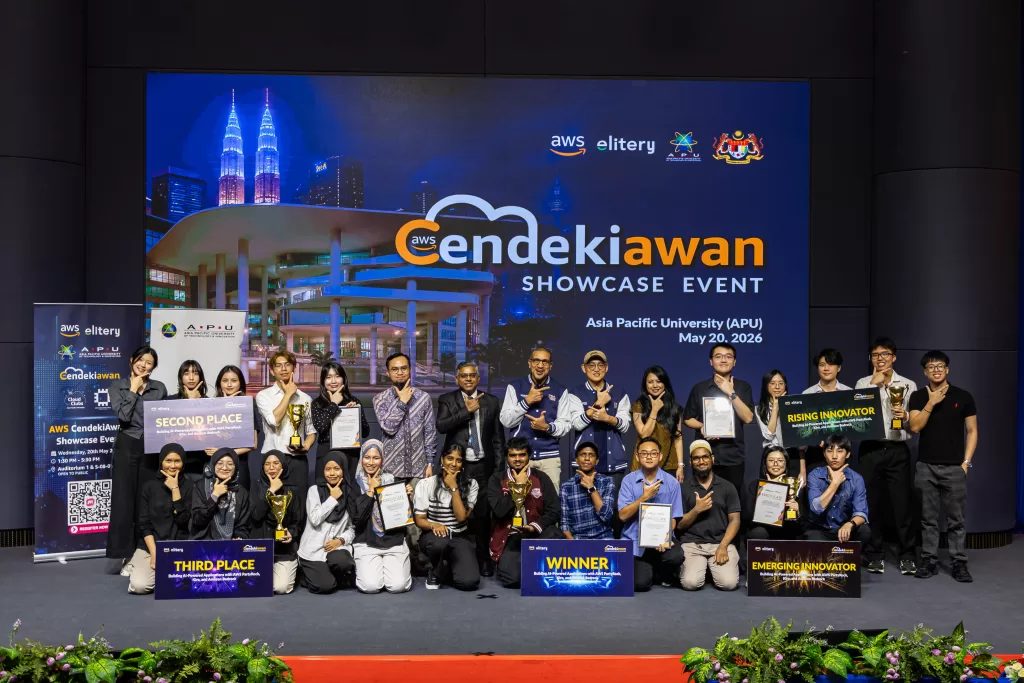
This three-month journey culminated in a competitive onsite hackathon where twenty finalist teams presented their production-ready solutions to a panel of industry judges. The resulting applications tackled serious, real-world issues across five specific categories. Team Viltrum took the GovTech category with City Mind MY, an AI-powered urban mobility platform designed to help local authorities simulate policies and improve traffic management. In the Smart Education space, Team EC 1+1 developed LangHub, an interactive platform dedicated to preserving and teaching regional dialects through adaptive conversations. For Financial Inclusion, Team Internelligence built SMEwise, an AI assistant engineered to help local small businesses manage their finances and optimise pricing. Furthermore, Team Mediguard won the Digital Health sector with a biometric screening tool for rural clinics to identify non-communicable disease risks, while Team Whoopie secured the Sustainability win with See You CO2, a daily carbon footprint tracker.
Beyond the hackathon, the program is heavily designed for long-term educational sustainability. AWS is providing APU students with twelve months of access to AWS Skill Builder, ensuring they can continue accessing instructor-led training and preparing for professional certifications. Furthermore, Elitery has actively trained around fifty APU lecturers and student leaders to act as AI Champions, giving the university the internal capability to run future student cohorts completely independently. As APU’s Chief Innovation and Enterprise Officer, Professor Vinesh Thiruchelvam, pointed out, these graduates are no longer just walking into job interviews with theoretical concepts; they are stepping into the workforce with functional, documented software they built and shipped themselves.