

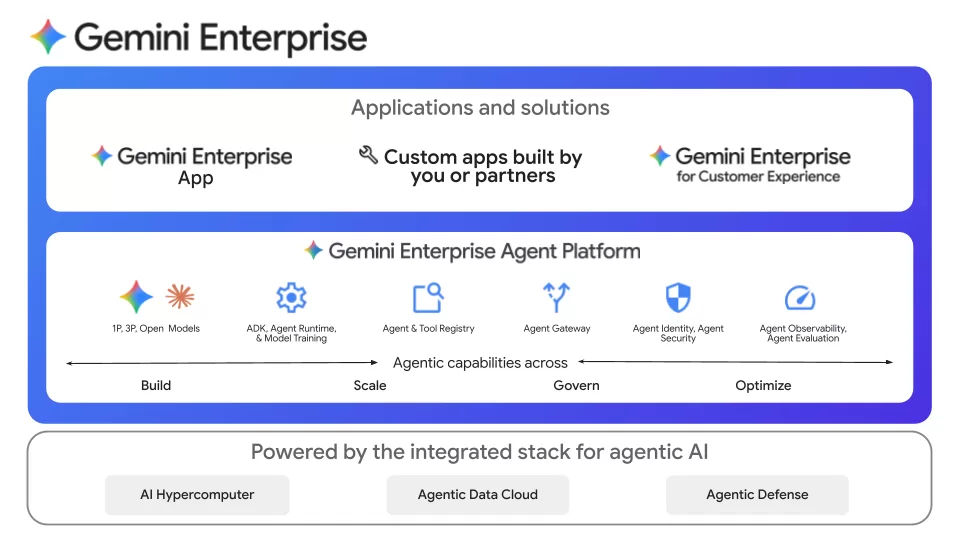
For the past couple of years, artificial intelligence has primarily functioned as a highly advanced search engine. You ask a chatbot a question, and it gives you a synthesised answer. Google is officially signalling that this purely conversational phase is over at Google Cloud Next. The tech giant has unveiled Gemini Enterprise, a massive, end-to-end ecosystem designed to shift AI from simply retrieving information to autonomously executing complex, multi-step business workflows. The platform essentially provides businesses with the tools to build, deploy, and govern a fleet of digital workers without compromising their internal corporate networks.

The Developer’s Engine Room
The technical foundation of this new initiative is the Gemini Enterprise Agent Platform. Positioned as the direct evolution of Google’s existing Vertex AI suite, this developer-centric hub is where software engineering teams can build and scale highly customised autonomous agents. Google is outfitting developers with an enhanced Agent Development Kit that utilises a new graph-based framework, allowing engineers to network multiple specialised sub-agents together to handle incredibly complex background processes.
Because an artificial intelligence is only truly useful if it remembers what you told it yesterday, Google is introducing Memory Banks and Memory Profiles. These features grant agents long-term contextual memory, allowing them to recall specific user preferences and historical data across entirely different computing sessions. Furthermore, these agents can securely delegate specific tasks to one another, drastically speeding up execution times for heavy enterprise workloads. For developers tired of pushing unverified logic, a new Agent Simulation tool allows teams to rigorously stress-test these digital workers against simulated real-world scenarios before they are ever deployed to the company at large.
Democratizing AI for the Everyday Worker
While the backend is built for hardcore software engineers, the everyday employee experience is housed within the Gemini Enterprise app. Google is framing this application as the front door for AI across the modern workplace. You do not need to know how to code to build a digital assistant here. The platform features a no-code Agent Designer that allows any standard knowledge worker to create personalised, trigger-based agents using simple, natural language commands.
Managing dozens of autonomous agents naturally requires a new kind of interface. To handle this, Google introduced Inbox in Gemini Enterprise. Instead of an inbox for emails, this acts as a centralised dashboard where employees can monitor their active, long-running agents, adjust configurations on the fly, and receive real-time alerts when an automated workflow is completed or hits a roadblock. To keep human teams and AI agents perfectly aligned, Google also rolled out Projects, a shared workspace that permanently retains the history and context of a specific topic, ensuring that critical project intelligence remains a permanent company asset even if team members change roles.
Reining in the Sprawl
Allowing every single employee to build and deploy autonomous AI agents sounds like an absolute nightmare for a corporate IT department. Google recognises this and has heavily integrated strict governance directly into the platform’s architecture. Gemini Enterprise provides a single, unified control plane that gives IT administrators complete, centralised visibility over every agent operating within the company network.
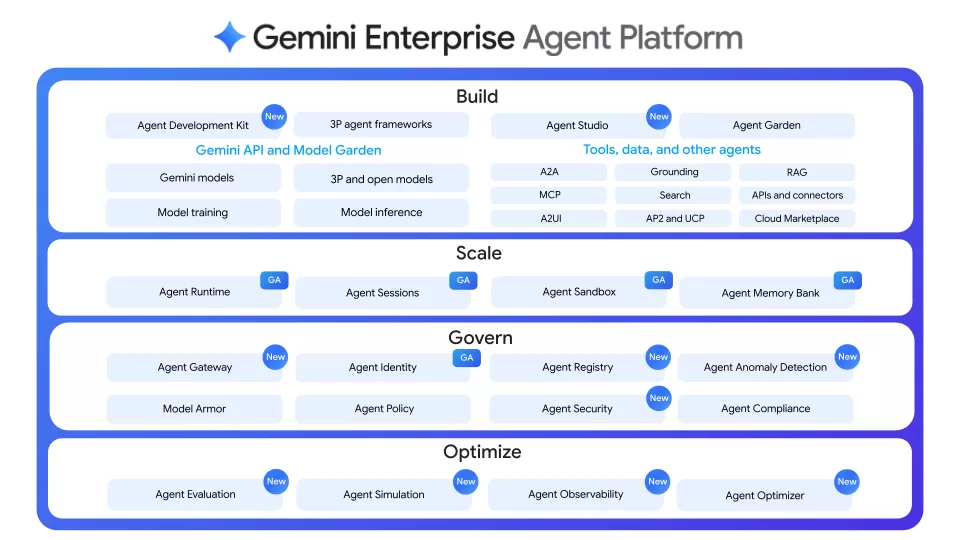
Enterprise-grade security is hardcoded into the system from the ground up. Every single agent is assigned a unique cryptographic identifier, ensuring that all activities are completely traceable and auditable. An Agent Gateway acts as an air traffic controller to heavily monitor all data interactions, while a dedicated Model Armor system actively defends the network against malicious prompt injections, tool poisoning, and sensitive corporate data leaks.
A Growing Partner Ecosystem
Google also understands that businesses do not want to build every single administrative tool from scratch. The agentic enterprise relies heavily on third-party integration, which is why Gemini Enterprise features a widely open partner ecosystem. Through the Agent Gallery, employees can easily discover and activate pre-built agents from major enterprise software leaders like Salesforce, ServiceNow, Oracle, Workday, and Adobe. Because these third-party agents are strictly validated by Google Cloud and managed within the exact same security framework, organisations can freely leverage external innovation without ever compromising their strict internal compliance standards.
Ultimately, Gemini Enterprise represents a massive structural shift in how businesses will operate. By combining powerful frontier models with highly accessible design tools and rigid, enterprise-grade security, Google is making it significantly easier for companies to confidently delegate their daily administrative burdens to the machines.