


Deploying a powerful artificial intelligence model is only half the battle for a modern enterprise. The real challenge often lies in the underlying digital plumbing. AI applications thrive in highly dynamic, data-heavy environments, but the traditional network architectures most enterprises rely on were simply never built to handle that kind of speed or complexity. Network engineers are currently forced to rely on slow, manual configurations to keep data flowing, creating massive operational bottlenecks and long deployment cycles. To eliminate this friction, digital infrastructure giant Equinix has officially launched Fabric Intelligence, a brand-new, AI-native operational layer designed to completely automate how enterprise networks are managed.

Chatting with Your Infrastructure
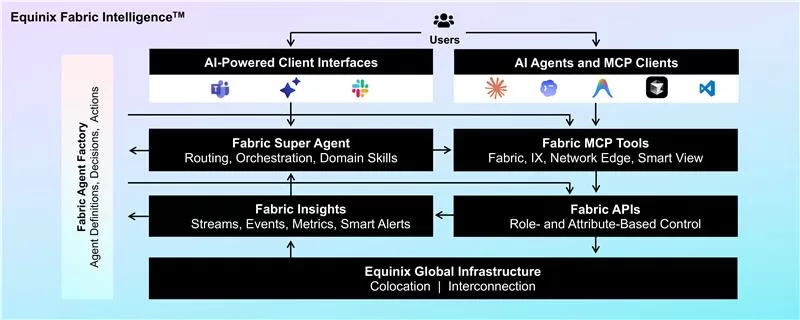
The most practical upgrade for daily IT operations comes in the form of the new Fabric Super Agent. Historically, configuring a massive enterprise network required navigating incredibly dense software interfaces and writing custom application programming interface scripts. Equinix is replacing that headache with natural language processing. Network administrators can now actively manage their infrastructure by simply typing requests directly into Slack, Microsoft Teams, or the standard Equinix Customer Portal. By allowing an autonomous AI agent to handle the heavy lifting of configuration and offer real-time performance recommendations, Equinix notes that the system can aggressively reduce standard deployment timelines from several weeks down to just a few minutes.
Bridging the Developer Gap
For the software engineers actually building these complex AI workflows, Equinix is rolling out a dedicated set of backend tools called the MCP Server. Using the Model Context Protocol, this feature allows developers to seamlessly integrate their physical network environments directly with top-tier, third-party AI coding clients. Whether a developer prefers using Claude Code, OpenAI Codex, Cursor, or VS Code Copilot, they can actively work alongside their preferred AI agents right inside their existing operational environment. This drastically simplifies the process of testing high-performance, low-latency connections for new AI systems.
Keeping Proprietary Data Off the Open Web
Naturally, feeding massive amounts of corporate data into an AI model raises severe security concerns. If an enterprise is training an agent on highly sensitive financial records or proprietary customer data, sending that information across the public internet is a massive risk. To solve this, the new suite includes Fabric Application Connect. This acts as a completely private, dedicated connectivity marketplace. It allows organisations to securely access foundational AI components—such as inference engines, training algorithms, and secure data storage—without ever exposing their sensitive workloads to the public web.
Predictive Maintenance and the Autonomous Future
Once the infrastructure is actively running, keeping it stable is handled by Fabric Insights. Instead of waiting for a connection drop to trigger an alarm, this AI-powered monitoring tool continuously analyses real-time telemetry data to actively predict network anomalies before they cause widespread outages. To ensure it fits into existing corporate security protocols, the tool natively integrates directly with major event management platforms like Datadog and Splunk.
Equinix is clearly betting heavily on a fully autonomous future, recently solidifying its structural commitment by joining the Agentic AI Foundation as a Gold member to help build open standards for the autonomous economy. Ultimately, as AI integration becomes mandatory for modern businesses, tools like Fabric Intelligence are explicitly designed to shift network infrastructure from being a sluggish operational constraint into a highly adaptive competitive advantage.