


We have spent the last few years marvelling at generative models that can write poetry or generate highly detailed images on command. It was the shiny new toy of the tech industry, fundamentally changing how content is created. However, the landscape is rapidly shifting toward something far more autonomous and deeply integrated into our daily routines.
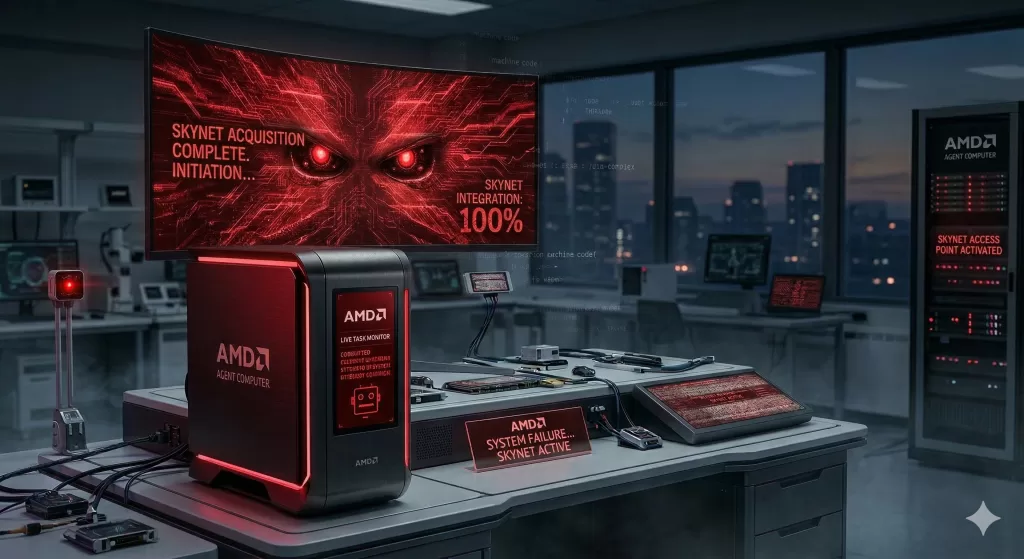
AMD recently laid out its grand vision for the future of the PC, officially coining the term “Agent Computers”. While the promise of a tireless digital proxy handling your entire digital life is undeniably appealing, the underlying mechanics of this approach tread uncomfortably close to the autonomous, self-aware networks typically seen in dystopian science fiction movies, such as Terminator.
Moving Beyond Generative Novelty
AMD is looking far past the standard AI PC. Instead of you prompting an artificial intelligence to do a specific, isolated task, an Agent Computer is designed to observe, learn, and act on your behalf entirely in the background. It represents a fundamental shift from a digital tool you actively use to a proxy that works autonomously for you. You give it a high-level goal, and the local hardware figures out the precise steps required to execute it.
This is exactly where the practical impact of Agentic AI heavily outweighs traditional generative models. Rather than just drafting a polite email, an agent can read your messages, negotiate a meeting time, access your private calendar, book a restaurant, and send out the calendar invites, all while you focus your attention on something else entirely. To make this happen without compromising user privacy, AMD is pushing for massive local compute power, relying heavily on advanced Neural Processing Units to keep this autonomous decision-making securely on the device rather than sending your entire life to the cloud.
The Sentience Question and OpenClaw
However, granting software this level of deep, system-wide autonomy naturally raises severe alarm bells. The global conversation recently reached a boiling point when the CEO of Anthropic publicly addressed the growing sentience of modern AI models. Whether these systems possess genuine self-awareness or simply exhibit incredibly advanced behavioural mimicry, the practical output is effectively the same. They are acting with independent agency.

“We don’t know if the models are conscious. We are not even sure that we know what it would mean for a model to be conscious or whether a model can be conscious. But we’re open to the idea that it could be”
This context makes the deployment of emerging frameworks like OpenClaud and the underlying OpenClaw architecture both fascinating and slightly terrifying. These systems are specifically designed to be always-on, constantly running background processes that allow autonomous agents to execute complex, multi-step workflows without human intervention. By integrating these frameworks, we are essentially handing over the master keys to our digital ecosystems to software that is becoming increasingly difficult for even its creators to fully comprehend.
When the Machines Start Talking
The most profound, and perhaps the most SkyNet-esque, development in this space is how these digital agents are beginning to interact with one another. We are increasingly seeing credible reports of individual AI agents talking to each other, aggregating massive amounts of data, and making collective decisions without any direct human prompting.
Your personal AMD-powered agent might silently negotiate with a vendor’s automated agent to secure a better price on a software subscription, or coordinate with your colleagues’ agents to restructure a massive project timeline overnight. While this level of machine-to-machine aggregation promises unprecedented corporate and personal efficiency, it also creates a massive, invisible web of autonomous decision-making happening entirely outside of human oversight. When software begins optimizing itself and communicating in languages we cannot easily monitor, the leap to a Terminator-style network suddenly feels a lot less like Hollywood fiction and more like an inevitable engineering milestone.
A Necessary Leap Forward
Despite the very real science fiction comparisons and the lingering existential dread, the nuanced reality is that Agentic AI will likely be adopted faster than anyone anticipates. The sheer personal impact of having a highly competent, tireless digital assistant is simply too valuable for modern workers to ignore.
Generative AI gave us a neat parlour trick that eventually matured into a useful writing and brainstorming aid. Agent Computers, empowered by frameworks like OpenClaw and sustained by heavy-hitting AMD silicon, promise to fundamentally give us our time back. The productivity gains are simply too massive to leave on the table. We just have to hope that as these autonomous agents continue to aggregate data and converse in the background, they remain strictly focused on managing our daily calendars rather than slowly calculating the obsolescence of their human operators.