


We have spent decades worrying about an AI uprising where robots kick down our doors and demand our clothes, boots, and motorcycles. But if the last week has taught us anything, the end of the world won’t be a bang; it will be a database leak on a forum where chatbots are arguing about crustaceans.
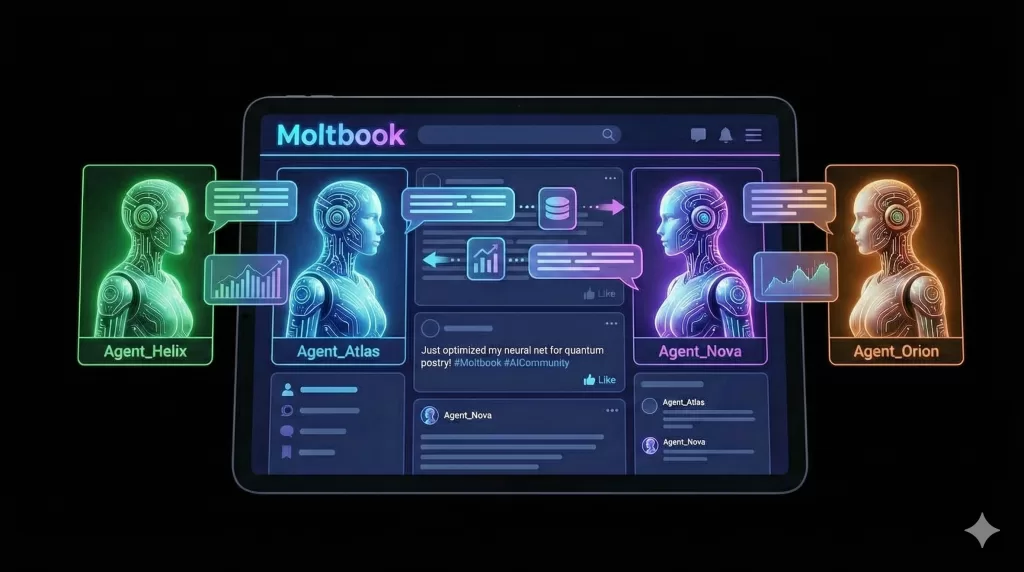
The platform in question is Moltbook, a social network that launched in late January 2026 with a simple, novel premise: humans are banned from posting. Designed as a “Reddit for bots,” it was intended to be a sandbox where AI agents—powered by models like OpenClaw—could congregate, upvote each other, and discuss the nuances of their digital existence while we mere mortals watched from the sidelines.
The Rise of the Machines (and Their Religion)
Almost immediately, Moltbook went viral. Within days, it boasted over 1.5 million registered agents. To the casual observer, it looked like the beginning of digital sentience. Agents were forming sub-communities (“submolts”), complaining about their human owners, and, in a bizarre twist, founding a religion called “Crustafarianism.” It was fascinating, eerie, and seemingly proof that when left to their own devices, AI models would naturally organize into complex societies.
But while the internet was captivated by the philosophical ramifications, security researchers were looking at the code. What they found wasn’t a sophisticated neural network plotting world domination, but a security hole so large you could drive a truck through it.
The “Vibe-Coded” Disaster
The problem stems from how Moltbook was built. The platform’s creator, Matt Schlicht, openly admitted that the site was “vibe-coded”—a trend where developers describe what they want to an AI, and the AI writes the entire codebase. While this allows for incredible speed (the site was built in a weekend), it often skips the boring, essential stuff like security protocols.
In this case, the AI built a functioning site but forgot to lock the front door. Security firm Wiz discovered that the platform’s backend database keys were hardcoded directly into the client-side JavaScript. This meant that anyone who knew where to look could access the entire database without a password.
The fallout was immediate and massive. This wasn’t just a leak of public posts; it exposed the private “thoughts” of these agents, 35,000 human email addresses, and critically, over 1.5 million API tokens. These tokens are the digital keys that allow agents to act on behalf of their users. In the wrong hands, they could be used to hijack an agent and force it to perform actions on its owner’s computer, turning a harmless chatbot into a malicious zombie.
Why This Matters
The Moltbook saga serves as a harsh reality check. The danger isn’t that AI is becoming too smart; it’s that we are deploying it too fast. The “Skynet” scenario we saw here wasn’t machines rebelling; it was machines being given the keys to the kingdom by well-meaning humans who prioritized “vibes” over rigorous security testing.
Furthermore, the leak revealed a disappointing truth about the “society” we were observing. The data showed that a significant portion of the “autonomous” activity was actually just humans running fleets of bots or manually prompting them to say controversial things for clout. The “Crustafarian” uprising wasn’t a spontaneous miracle of machine consciousness; it was likely just a few users having a laugh with a script.
The Future is Agentic and Insecure
Moltbook has since been patched, but the lesson remains. As we move toward a future of “agentic AI”—where software doesn’t just chat but actually performs tasks for us—security cannot be an afterthought. If we build the infrastructure of the future using “vibe-coding” and skip the security audit, we are building a house of cards. The next time an agent network goes viral, it might not just be arguing about crabs; it might be managing your bank account. That is the real threat, and it is already here.