

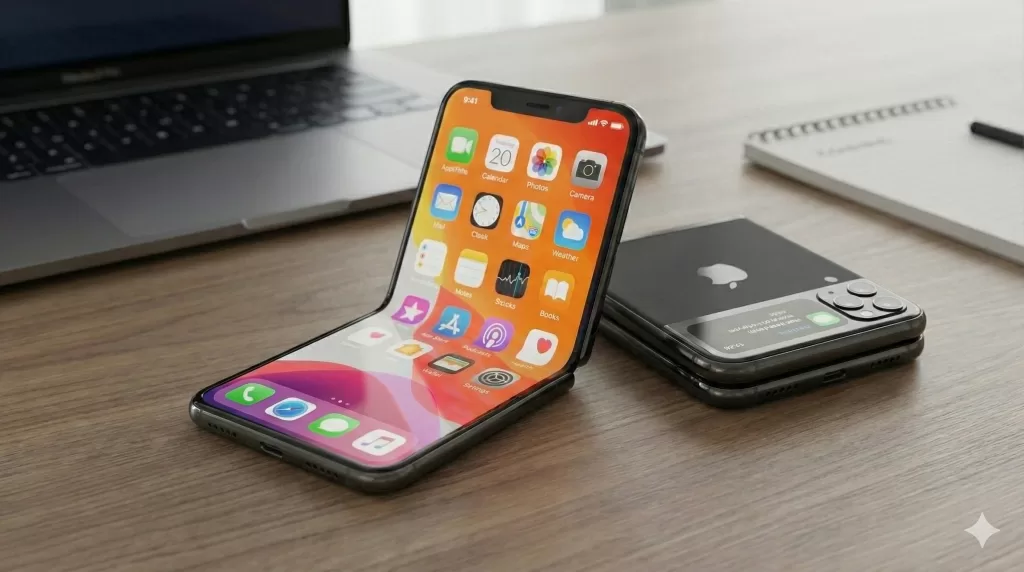
For years, the rumor mill has churned out whispers of an “iPhone Fold,” usually describing a book-style device similar to the Galaxy Z Fold series. However, a new report from Bloomberg suggests that Apple’s ambitions might be more diverse than a single device. The company is reportedly exploring a clamshell-style foldable—colloquially dubbed the “iPhone Flip”—as a potential follow-up to its initial entry into the foldable market.
A Roadmap, Not Just a Release
According to Bloomberg’s Mark Gurman, Apple is actively considering a vertically folding device that mimics the form factor of the classic flip phone. This device would essentially take the standard iPhone experience and fold it in half, creating a pocketable square that expands into a full-sized display. The crucial detail here is the timeline and strategy. The “Flip” is not expected to be Apple’s first foldable. Instead, the current roadmap seemingly prioritizes a larger, book-style “iPhone Fold” (rumored for late 2026) as the debut device. The clamshell model is being evaluated as a secondary wave, contingent on the success of that first launch. Essentially, Apple wants to prove the category is viable with a premium, iPad-hybrid device before committing to the more consumer-focused flip style.
Specs and Design Expectations
While the device is still in the “consideration” phase, industry leaks paint a picture of what Apple is aiming for. The goal appears to be parity with the standard iPhone experience but in a more compact footprint. In terms of the display, the inner screen is expected to be a flexible OLED panel, likely supplied by Samsung Display, utilizing a new “crease-free” technology that employs a laser-drilled metal support plate. This would address one of the biggest complaints about current foldables. The cover screen would likely be larger than current competitors, potentially occupying the entire top half of the folded device to allow for widget interaction without opening the phone.
On the durability front, reports indicate Apple is experimenting with a “liquid metal” hinge alloy. This material is known for high strength and elasticity, theoretically allowing for a thinner, more durable mechanism that can withstand years of opening and closing without the fatigue seen in standard aluminum or steel hinges. Unlike the book-style fold which might prioritize productivity, a flip-style iPhone would likely focus on social features, leveraging the folded state for tripod-free selfies and content creation—a feature set that has made the Galaxy Z Flip popular among younger demographics. Performance-wise, if it follows the projected timeline, the device would likely run on a future A-series chip (potentially the A20 or A21), ensuring it matches the Pro-series iPhones in raw power.
The “Wait and See” Strategy
This reported dual-device strategy highlights Apple’s typical approach: let competitors beta-test the market, then enter with a polished ecosystem. By waiting until late 2026 or beyond, Apple avoids the early teething problems of fragile screens and bulky hinges. The “Flip” concept specifically targets a different audience than the “Fold”—one that values portability and fashion over raw screen real estate. However, “under consideration” is the key phrase. Apple has a history of killing projects deep into development if they don’t meet quality standards. The existence of prototypes doesn’t guarantee a release, but it does confirm that Apple sees foldables as a potential staple of its future lineup, rather than just a niche experiment.