


Malaysia has spent the last few years rolling out 5G infrastructure, but for many businesses, the question remains: “What do we actually do with it?” deploying advanced network solutions is expensive and risky. Addressing this gap between potential and practice, U Mobile has launched the Enterprise Innovation Platform (EIP). Think of it less as a product and more as a neutral testing ground where businesses can figure out if their 5G and AI ideas actually work before spending millions on a full rollout.
The core philosophy here is creating a safe space for innovation. U Mobile describes the platform as agnostic, meaning it is designed to be a neutral environment where enterprises, SMEs, and even government agencies can collaborate without being locked into a single vendor’s ecosystem from day one. The initiative operates on a structured “Develop, Test, and Demonstrate” framework. This allows a logistics company, for example, to build a prototype for autonomous tracking, stress-test it under real-world network conditions, and then prove it works to stakeholders, all within a supported ecosystem.
To give this digital concept a physical home, U Mobile is establishing the EIP Hub at Subang Hi-Tech Park, scheduled to open its doors in July 2026. This facility is set to be a fully equipped sandbox powered by U Mobile’s ULTRA5G network. It will grant innovators access to 5G-Advanced (5G-A) connectivity, private network zones, and edge computing resources. The hub will also feature specialized tools like digital twins—virtual replicas of physical systems—allowing a factory manager to simulate a production line overhaul digitally before moving a single physical machine.
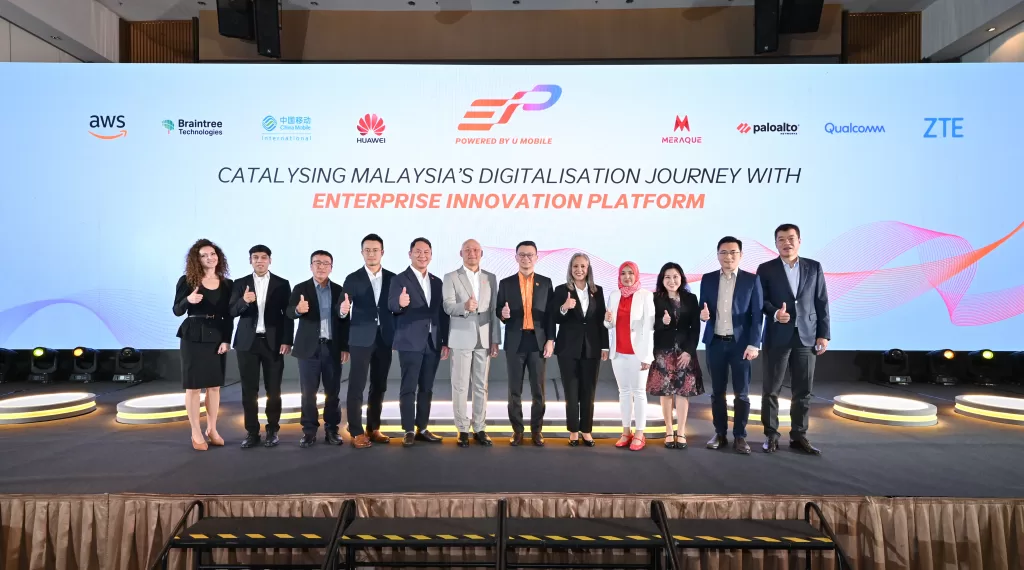
Of course, a platform is only as good as the tools available within it. U Mobile has secured a lineup of heavyweight partners to ensure the EIP isn’t just an empty room with fast internet. The initiative is supported by four “Anchor Partners” who provide the critical infrastructure. Amazon Web Services (AWS) brings its massive cloud and AI capabilities, while Huawei contributes the radio and core network platforms. Palo Alto Networks ensures the environment is secured with enterprise-grade Zero Trust frameworks, and Qualcomm offers the necessary expertise in chipsets and device enablement.
Complementing these giants are specialized technology partners who bring specific use cases to the table. This includes Meraque Group, known for its drone and robotics tech, and Braintree Technologies, which focuses on automation. China Mobile International and ZTE Malaysia round out the group, providing deployment insights and network platforms.
By congregating these resources under one roof, U Mobile is effectively lowering the barrier to entry for Malaysian businesses. Instead of navigating a fragmented landscape of vendors and integrators, enterprises now have a centralized hub to validate their future—turning 5G from a buzzword into a workable business strategy.