

For the past three decades, ARM’s business model has been relatively straightforward: they design the intricate intellectual property and compute architecture, then license it out to other tech giants to actually manufacture the chips. However, the rapidly escalating demands of artificial intelligence are forcing the industry to adapt. In a monumental shift that fundamentally rewrites their 35-year history, Arm has just announced the Arm AGI CPU. It is their very first piece of proprietary, production-ready silicon built specifically for data centres, and it is squarely aimed at the next generation of artificial intelligence.
A Pivot from Licensing to Manufacturing
The shift from simply licensing architecture to selling physical hardware is massive. Up until now, partners had to choose between licensing Arm’s intellectual property or adopting their Compute Subsystems to build their own custom processors. With the introduction of the AGI CPU, companies can now purchase Arm-designed silicon directly off the shelf.
The driving force behind this unprecedented pivot is something called Agentic AI. Unlike the generative AI chatbots we interact with today, which require a prompt for every action, Agentic AI systems are designed to reason, plan, and execute complex tasks autonomously. This requires a staggering amount of sustained computing power and an entirely new approach to orchestration within large-scale server racks. Rather than waiting for someone else to build the perfect chip for this new era, Arm partnered directly with Meta to co-develop a processor that handles these immense workloads efficiently.
Breaking Down the Hardware
From a technical standpoint, the Arm AGI CPU is an absolute powerhouse designed specifically for scale and density. The processor is built on the advanced 3nm manufacturing process by TSMC and packs up to 136 Arm Neoverse V3 cores per CPU. Where this chip truly shines is in its memory bandwidth and latency management. It delivers an impressive 6GB/s of memory bandwidth per core while maintaining a sub-100 nanosecond latency.
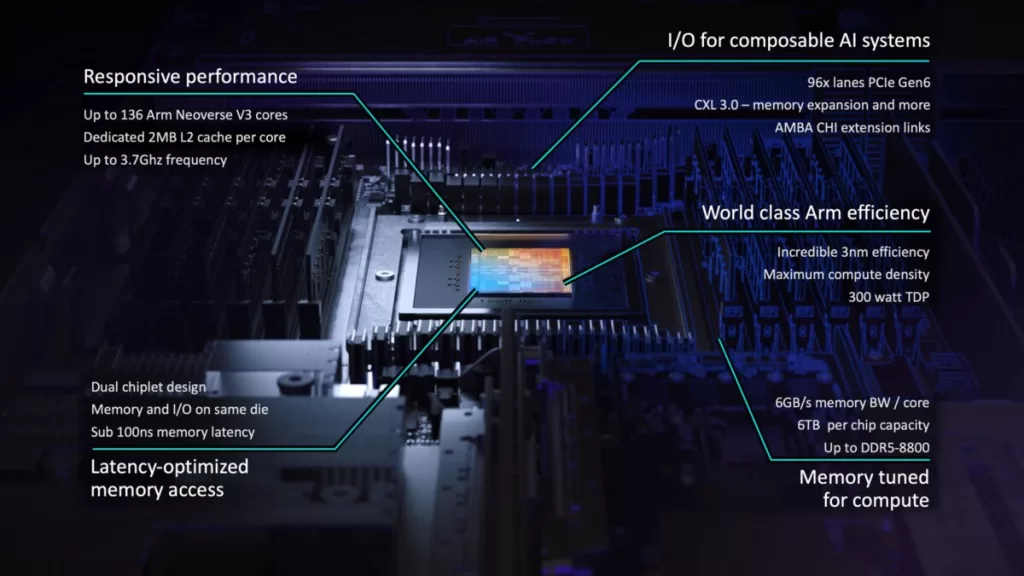
What makes this particularly interesting for data centre operators is the power efficiency. The chip operates on a 300-watt thermal design power profile and uniquely assigns a dedicated core per program thread. In practical terms, this means the processor can sustain incredibly heavy workloads without throttling performance or wasting energy on idle threads. It allows companies to pack a staggering amount of compute into a very confined space. An air-cooled 1U server chassis can now support up to 8,160 cores per rack, while liquid-cooled setups can push that number past an astonishing 45,000 cores. According to Arm, this density translates to more than double the performance per rack compared to current x86 systems.
Turning up the Heat for Manufacturing Partners
While a data centre processor might sound disconnected from your daily tech usage, the trickle-down effects of the AGI CPU are going to be significant. Meta, as the lead partner, is already planning to integrate these processors alongside their custom accelerators to optimise the infrastructure that runs Facebook, Instagram, and WhatsApp. By dramatically increasing compute density and power efficiency, companies can train smarter, faster, and more capable AI models without requiring a proportional increase in physical space or massive spikes in energy consumption.
Beyond Meta, a heavy-hitting roster of deployment partners including OpenAI, Cloudflare, and SAP are already lining up to integrate the silicon into their operations. Commercial systems from manufacturers like Supermicro and Lenovo are expected to see broader availability in the second half of 2026. Ultimately, Arm’s bold decision to manufacture their own hardware is not just a strategic business move to capture a larger share of the lucrative AI market; it is a catalyst that will accelerate the arrival of autonomous, hyper-intelligent software tools we will soon rely on every single day.