

Just a month ago, Google introduced Lyria 3, a highly capable artificial intelligence model that let users generate thirty-second musical clips from a simple text prompt. It was a neat technical showcase, perfect for social media snippets, but hardly a tool for serious musical production. That brief window of experimentation is already over. Google has officially launched Lyria 3 Pro, a massively upgraded generative model that completely shatters previous time restrictions, allowing users to create highly structured, studio-quality songs up to three full minutes in length. It is a stunning technological achievement, but it inevitably forces us to ask a difficult question: can an algorithm actually replace human musicians?
The Automation of Musical Architecture
The leap from thirty seconds to three minutes is significant, but the real marvel of Lyria 3 Pro lies in its newfound comprehension of musical composition. The system no longer just spits out a static loop of generic sound. It fundamentally understands how a proper song needs to breathe, build, and resolve.
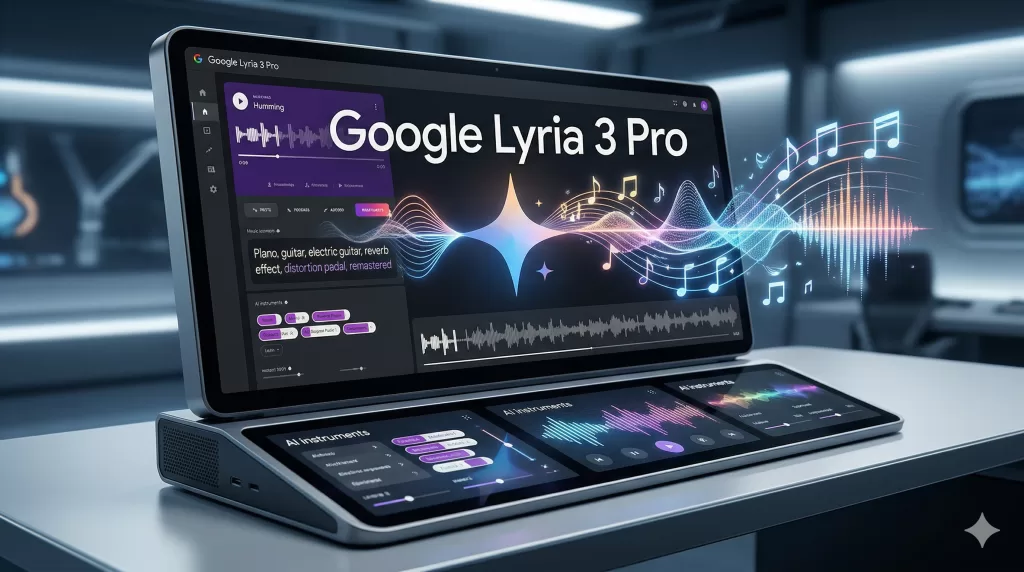
When typing out a prompt, you can now explicitly dictate the precise flow of the track. You can ask the AI for a slow acoustic intro, demand a heavy vocal chorus at a specific timestamp, and orchestrate a seamless transition into a bridge. You can even provide custom lyrics and tell the synthesized vocalist exactly when to start singing. Furthermore, the model fully supports multimodal inputs. If you cannot quite describe the specific genre you want, you can simply upload a photograph of a rainy street or a bustling cafe. The AI will instantly analyze the visual context and generate a complete, emotionally matched 48kHz stereo track based entirely on that image.
Mass Market Deployment
This level of production power is not locked away in an experimental research lab for engineers. Google is aggressively deploying Lyria 3 Pro across its entire software ecosystem, making it incredibly accessible to the public. Everyday consumers subscribed to the paid tiers of the Gemini app can start generating full tracks right now. Corporate users can utilize the model directly within Google Vids to generate instant, custom background music for presentations. Meanwhile, developers and massive enterprise clients are tapping into the raw capabilities through Google AI Studio and Vertex AI. Google has even integrated it into ProducerAI, a collaborative tool designed to help actual songwriters iterate on complete tracks.
Can It Replace Human Artistry?
From a purely pragmatic perspective, the appeal for content creators and businesses is undeniable. Why pay for stock music licensing when you can generate a bespoke, royalty-free track for your video in seconds? This extreme convenience is exactly why the music industry is watching the technology so closely. However, rather than declaring the absolute end of the working musician, we have to look at what the technology actually provides.
Lyria 3 Pro is a tool for generating background ambience, prototyping rough ideas, and democratizing audio production for those without formal musical training. But music is inherently driven by human emotion, lived experiences, and cultural context—elements that an algorithm simply synthesizes rather than truly feels. Google is also actively implementing safety guardrails to protect existing creators, such as embedding the SynthID digital watermark into every single generated track and refusing to directly clone the proprietary voices of real-world artists.