

For years, AI models have processed images in a very specific, limited way. They take a single, static glance at a picture—much like a human quickly scanning a room—and then try to answer questions based on that frozen moment. If the detail was too small, too blurry, or just missed in that initial pass, the model was forced to guess. This week, Google introduced a new capability for its Gemini 3 Flash model called “Agentic Vision” that fundamentally changes this dynamic, turning the act of seeing into an active investigation.
The core concept behind Agentic Vision is moving from a passive “look” to an active “loop.” Instead of just ingesting pixels, Gemini 3 Flash now operates on a “Think, Act, Observe” cycle. When presented with a complex visual query, the model doesn’t just guess. It formulates a plan. It might decide it needs to zoom in on a specific corner of a schematic, or perhaps count the number of items on a shelf more accurately. To do this, it doesn’t just rely on its neural network; it writes and executes Python code to manipulate the image in real-time.
This ability to effectively “use tools” on an image solves some of the most persistent hallucinations in multimodal AI. Take counting, for example. Asking an AI to count the number of fingers on a hand or windows on a building is notoriously error-prone. With Agentic Vision, Gemini 3 Flash doesn’t just eyeball it. It can write code to draw bounding boxes around each object it detects, assigning a number to each box. This “visual scratchpad” allows it to verify its own work, ensuring the final answer is grounded in hard evidence rather than a probabilistic estimate.
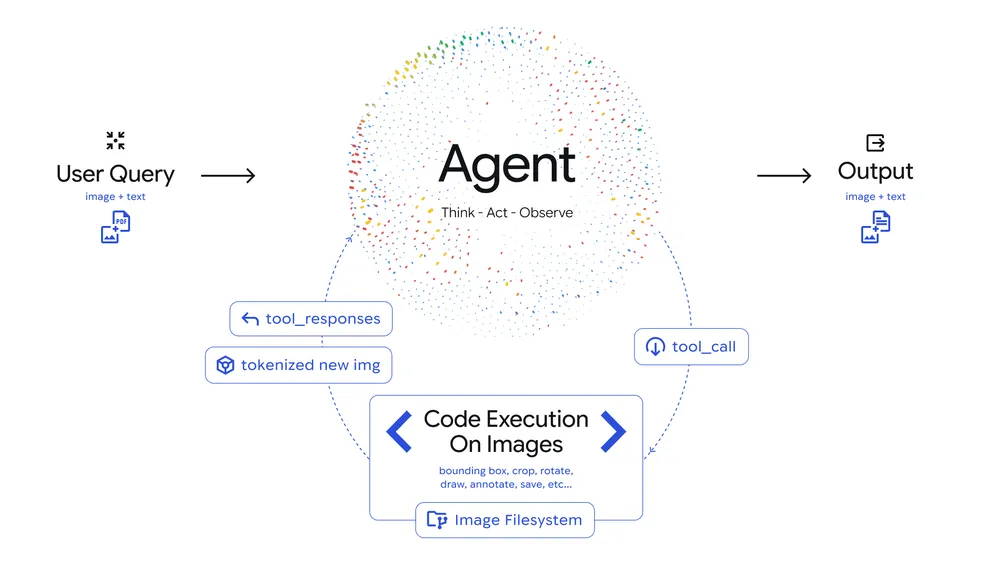
The feature also extends to data analysis. We have all seen AI struggle to accurately read dense charts or graphs. Agentic Vision allows Gemini 3 Flash to parse a high-density table and then write code to re-plot that data into a new, verified chart using libraries like Matplotlib. This replaces the “vibe-based” math of standard LLMs with deterministic, code-backed calculation.
Currently, this capability is rolling out to developers via Google AI Studio and Vertex AI. While some behaviors, like zooming, are already implicit—meaning the model knows when to do it without being asked—Google is working on making other actions like image rotation and complex visual math just as automatic. For now, it represents a significant step away from AI that simply watches the world, toward AI that actively scrutinizes it.