
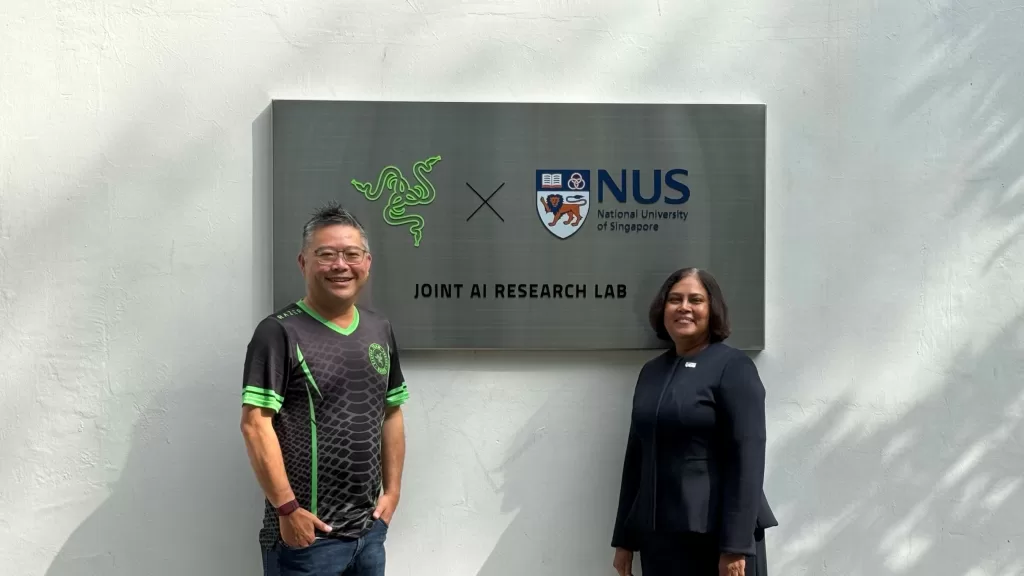
Artificial intelligence is rapidly shifting from background automation into the core architecture of interactive entertainment. To define the next phase of this evolution, Razer has partnered with the National University of Singapore’s School of Computing to launch the Razer-NUS Joint AI Research Lab. Hosted directly within NUS in Singapore, this joint initiative combines academic research with live industry engineering. The lab focuses on foundational artificial intelligence across hardware, software, and services, driving a projected market that industry analysts expect to reach US$66.8 billion by 2035. With nearly 80% of players receptive to AI features that enhance gameplay, this collaboration establishes a scientific foundation designed to transform how millions interact with digital worlds.
Gaming Artificial Narrow Intelligence (GANI)
At the centre of the lab’s research agenda is Gaming Artificial Narrow Intelligence, or GANI. Unlike generalised models that struggle with low latency or complex virtual rulesets, GANI represents a new research domain purpose-built for interactive digital environments. The objective is to construct AI models capable of processing live match state data instantly. In practice, GANI can power adaptive synthetic teammates that analyse a player’s skill level and playstyle in real time. Rather than relying on rigid, pre-scripted behaviour trees, these entities can adjust combat tactics on the fly, generate context-aware dialogue, and dynamically scale match difficulty to maintain competitive fairness. This real-time adaptability forms the underlying engine that powers both software companions and specialised hardware across Razer’s ecosystem.
Razer AVA: The Digital Human Companion

Applying GANI concepts to interactive software interfaces leads directly to Razer AVA, the brand’s vision for a digital human companion. Moving beyond basic voice assistants or static non-player characters, AVA is engineered as an intelligent entity equipped with persistent memory, personality, and situational awareness. The Razer-NUS lab is refining the core model innovation and advanced personalisation algorithms required to make these digital human interactions feel fluid and authentic. AVA tracks live gameplay context, offering tailored strategic advice, remembering previous player decisions, and adapting its conversational cadence over time. This software framework bridges the gap between passive utility tools and active digital partnership, establishing a new benchmark for software companions in modern gaming.
Project Motoko: The Wearable Ambient AI Headset

On the hardware front, the research lab provides the foundational intelligence for Project Motoko, an experimental wearable AI headset. Designed to bring multimodal generative capabilities into an everyday form factor, Project Motoko explores how spatial awareness and ambient intelligence can exist seamlessly on a player’s head. The headset combines optical sensors and spatial audio drivers with real-time processing, allowing the device to perceive the user’s physical surroundings alongside on-screen action. By processing environmental data natively, the wearable delivers instantaneous context without cluttering the screen or interrupting player focus. This hardware integration highlights how ambient intelligence can transition from localised desktop software into lightweight, wearable consumer gear.
The Razer-NUS AI Initiative and Global Expansion
The establishment of the joint research lab marks a major milestone in Razer’s global strategy, strengthening its existing AI Centre of Excellence in Singapore, which already houses roughly one hundred researchers, engineers, and data scientists, alongside its platform facility in France. By combining NUS Computing’s academic expertise with Razer’s live engineering environment, the lab operates on an iterative research-to-translation model. Successful breakthroughs validated in simulated testing will feed directly into Razer’s proprietary consumer products, while foundational findings will be shared through open academic channels to benefit the wider development community.