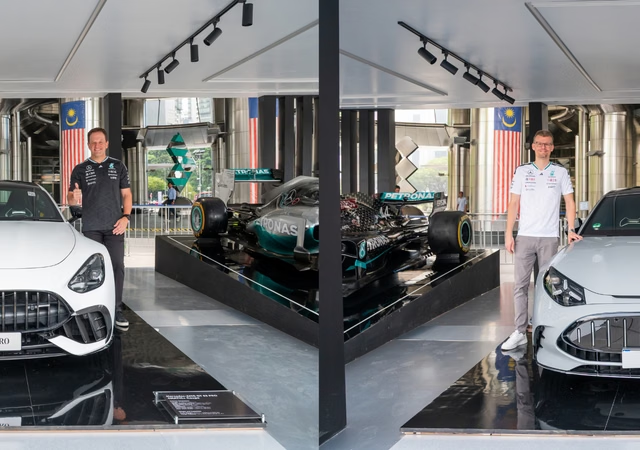

Synology has officially expanded its footprint in Malaysia with the general availability of the PAS7700 storage system. This is an enterprise solution explicitly designed to anchor mission-critical workloads where even a few seconds of unexpected downtime is completely unacceptable.
The PAS7700 Active-Active Base System
At the core of this new enterprise lineup is the main PAS7700 appliance, a massive 4U rackmount chassis that marks a significant step forward for Synology’s high-availability storage portfolio. Unlike traditional active-standby configurations, where a secondary backup controller sits completely idle waiting for a system failure, the PAS7700 utilises a true active-active architecture. Both of its internal controllers operate simultaneously. This means that if a hardware component or a network link fails unexpectedly, the secondary node manages the data traffic immediately without forcing a jarring system reboot or causing any drop in service continuity.
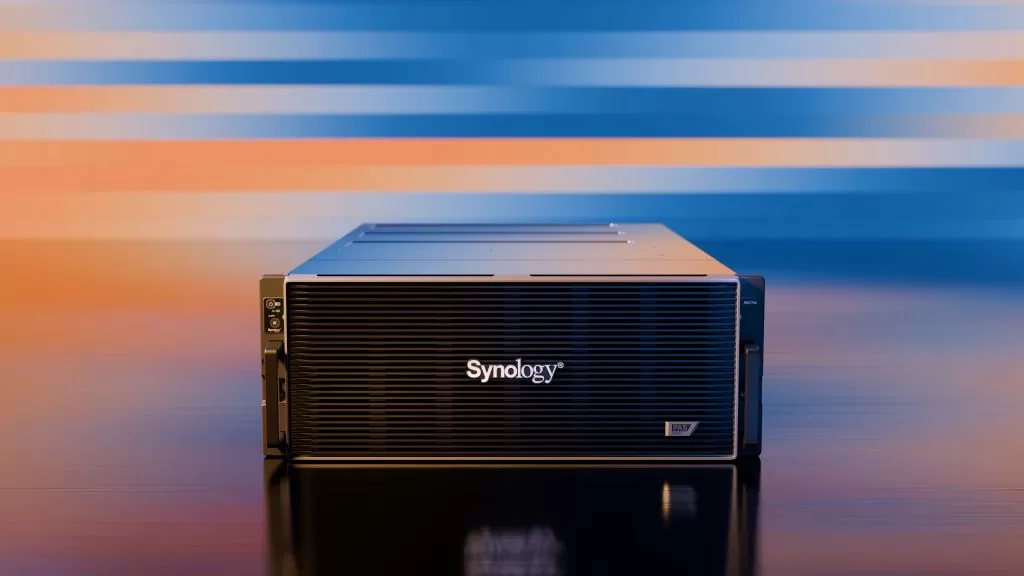
On a hardware level, the base unit features 48 NVMe SSD bays and supports up to 2,048 GB of system memory across the entire platform. Paired with high-speed 100GbE networking, it delivers up to 2 million IOPS and a sequential throughput of up to 30 GB/s with sub-millisecond latency. For businesses running heavy virtualised workloads or high-frequency databases, this means immediate file access and fluid daily operations under heavy multi-user stress.
Expansion Units and Form Factor Scalability
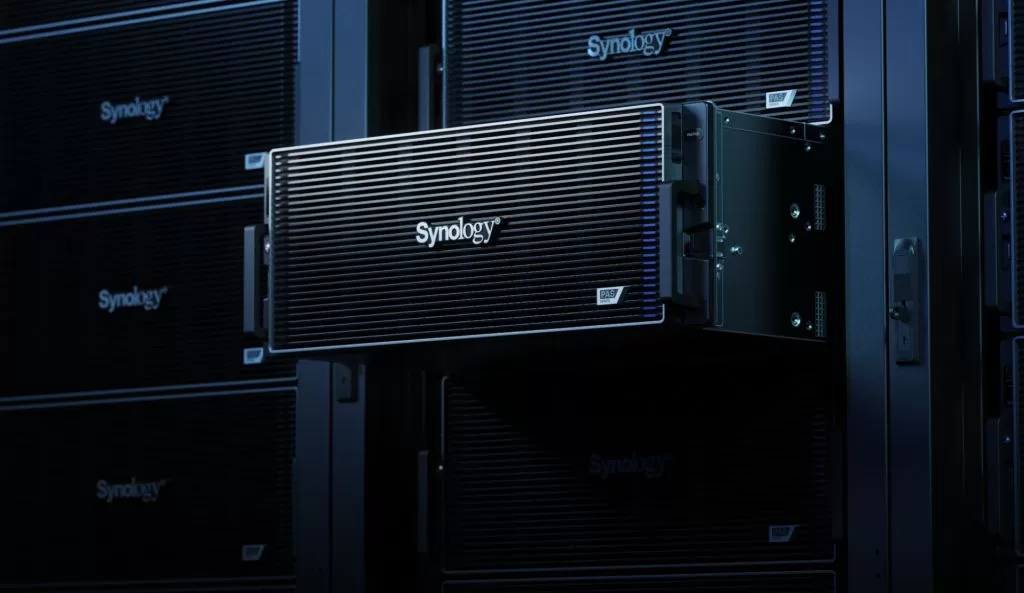
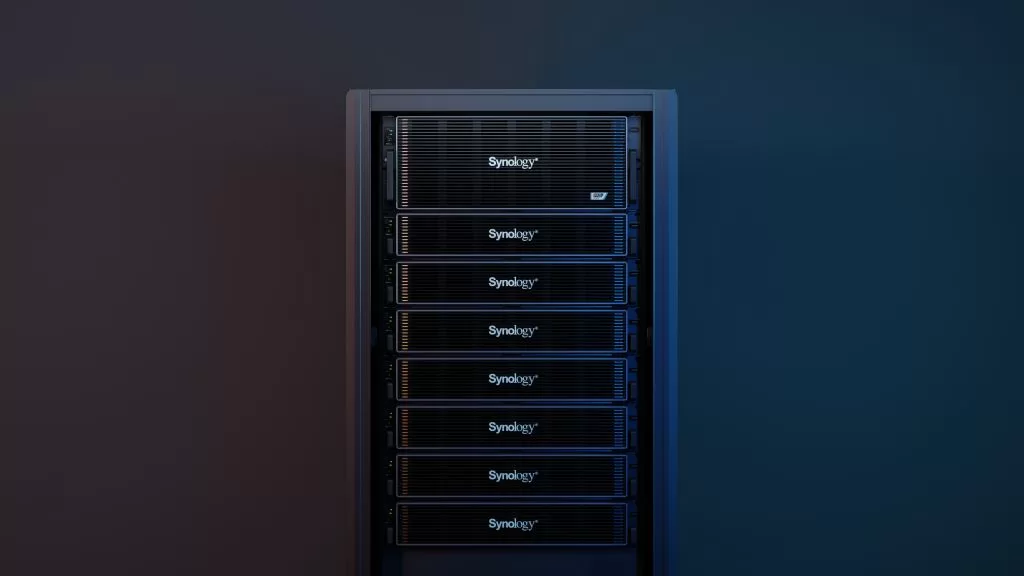
Enterprise needs can change at a moment’s notice, and over-provisioning storage before you actually need it strains an immediate IT budget. Synology addresses this issue by making the PAS platform highly modular. While the primary system starts as a single 4U appliance, IT managers can daisy-chain up to seven separate expansion units to scale their deployment seamlessly as data demands grow.
This scalable architecture allows businesses to expand their raw storage capacity up to a staggering 1.65 PB. The flexibility extends directly to protocol support, giving enterprise teams the freedom to manage both file and block storage over NVMe-oF, iSCSI, Fibre Channel, SMB, and NFS protocols. By providing these diverse connectivity form factors, the lineup adapts smoothly to pre-existing server infrastructures, making it a viable long-term foundation for companies preparing for future artificial intelligence integration and heavy data analytics without requiring a complete system overhaul.
Data Protection and DSM Enterprise Integration
Raw hardware power means very little if your corporate data remains vulnerable, especially given the increasingly challenging cybersecurity landscape in Malaysia. Local data breaches have become exceptionally costly, with recent reports from PIKOM indicating that the average cost of a single major data breach climbed to RM3.2 million, with some organisations suffering losses exceeding RM5 million. The PAS7700 combats these modern threats through deep hardware and software integration. It features native support for Self-Encrypting Drives (SEDs), ensuring hardware-level protection that secures sensitive data without dragging down the ultra-low latency system performance.
The entire platform runs on DSM Enterprise, balancing top-tier performance with operational simplicity. The OS introduces WORM (Write Once, Read Many) folders and immutable snapshots to protect backups from ransomware tampering. For long-term storage efficiency, inline and offline deduplication minimise unnecessary storage footprints and extend SSD lifespan. Synology will also introduce a smart tiering feature in the near future, automatically moving cold data to high-capacity secondary systems to free up premium NVMe resources for active applications.
Pricing & Availability
The Synology PAS7700 enterprise storage system is now officially available across Malaysia through Synology’s established network of authorised commercial partners and enterprise distributors. Because these enterprise deployments are highly customised based on memory configurations, drive capacities, and the specific number of scaling expansion units required, standard flat retail pricing has not been explicitly detailed.