
When we talk about artificial intelligence, the spotlight usually falls on massive graphics processors and the complex algorithms they run. However, the unsung hero keeping these systems fed with data is memory. Without ultra-fast storage and RAM, even the most powerful processors will simply sit idle waiting for information. Recognising this critical bottleneck, Samsung Electronics arrived at NVIDIA GTC 2026 in San Jose with a clear mission. They set out to showcase exactly how they plan to keep the AI revolution moving at breakneck speeds. As the only semiconductor company offering a complete suite spanning memory, logic, foundry, and advanced packaging, their latest announcements represent a massive leap forward for both enterprise data centres and the devices in our pockets.
Pushing the Boundaries with HBM4 and HBM4E
The absolute crown jewel of Samsung’s showcase is their high-bandwidth memory lineup. Right now, their sixth-generation HBM4 is already in mass production and is specifically designed to support the NVIDIA Vera Rubin platform. Built on an advanced 10-nanometer-class DRAM process, it delivers consistent processing speeds of 11.7 gigabits per second. This far exceeds the current industry standard of 8 Gbps and comes with the potential to be pushed up to an impressive 13 Gbps.
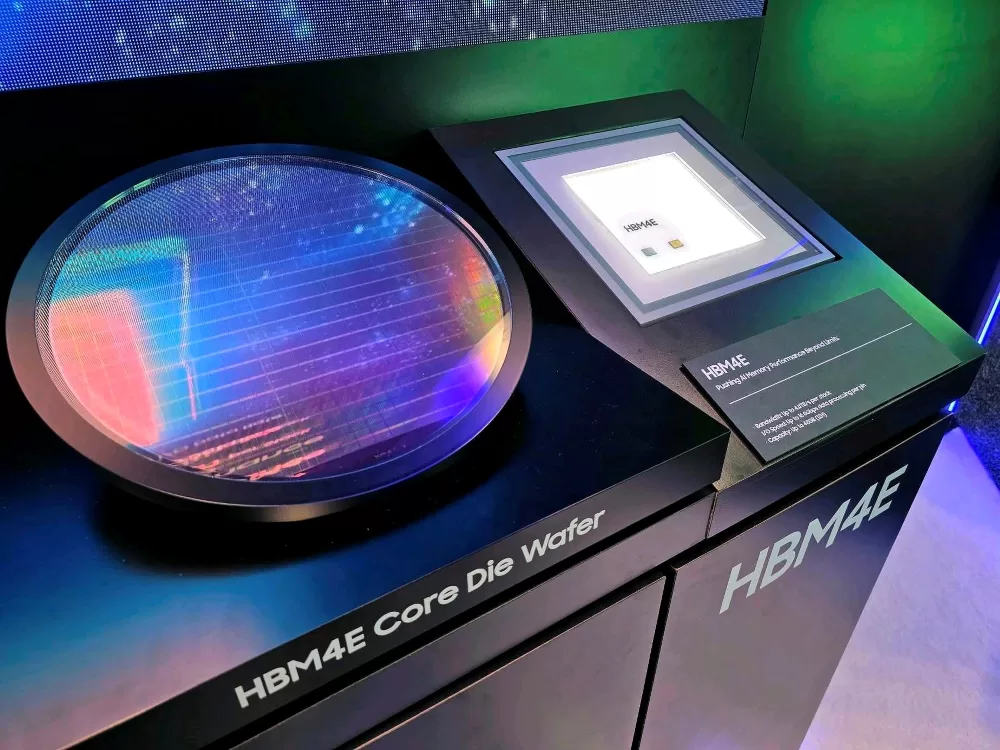
Samsung didn’t stop there, giving the public a highly anticipated first look at the brand-new HBM4E. This next-generation chip pushes the envelope even further, delivering a staggering 16 Gbps per pin and an overall bandwidth of 4.0 terabytes per second. To achieve this performance without melting the servers they sit in, Samsung introduced a new manufacturing method called hybrid copper bonding. This technique allows them to stack 16 or more memory layers while simultaneously reducing heat resistance by over 20% compared to older thermal compression methods. It is a brilliant engineering feat that practically addresses the massive thermal challenges faced by modern server racks.

Optimising the Server Rack
Beyond pure speed, Samsung focused heavily on infrastructure efficiency. Taking centre stage in their dedicated NVIDIA Gallery was the SOCAMM2. Based on low-power DRAM, this server memory module is built for flexible system integration and high bandwidth. Crucially, it is already in mass production, marking an industry first that provides immediate relief for organisations struggling to efficiently scale their AI operations.
Storage also saw a significant upgrade. Samsung demonstrated its new PM1763 SSD, which leverages the blazing-fast PCIe 6.0 interface to handle extreme data transfers seamlessly. Working in tandem with NVIDIA’s SCADA programming model, it provides the high-capacity foundation needed for massive AI storage solutions. For inference workloads where energy efficiency is paramount, they also highlighted the PM1753 SSD running on the new NVIDIA BlueField-4 STX reference architecture.
Bringing AI Power to Your Pocket
While data centre technology is fascinating, Samsung also made sure to address how this trickle-down innovation affects our daily lives. Localised AI processing on personal devices is the next major frontier, and Samsung’s memory solutions are geared precisely for this shift. They introduced tailored hardware like the PM9E3 and PM9E1 NAND for personal AI supercomputers, ensuring robust local intelligence without constant cloud reliance.
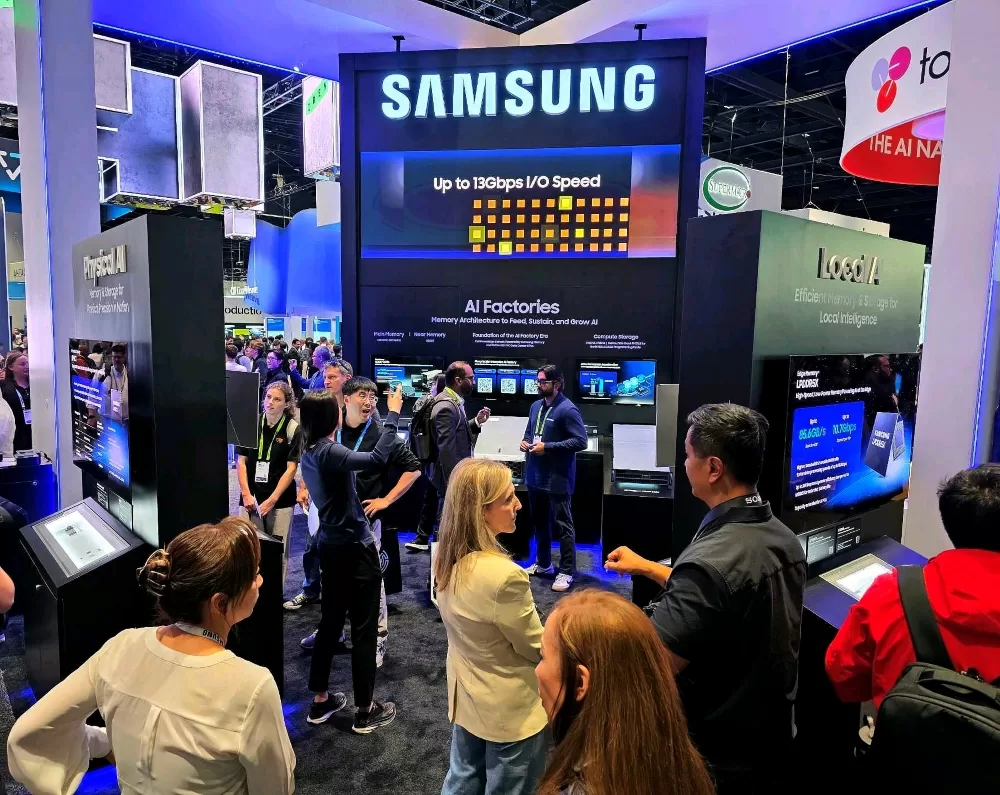
For premium smartphones, tablets, and wearables, the focus shifts to balancing raw power with battery endurance. Samsung’s LPDDR5X delivers speeds of up to 25 Gbps per pin while slashing power consumption by up to 15%. This means you get ultra-responsive mobile experiences and high-resolution gaming without constantly reaching for a charger. Looking slightly further ahead, the newly displayed LPDDR6 pushes mobile bandwidth to a scalable 30 to 35 Gbps per pin. By introducing advanced power-management features like adaptive voltage scaling and dynamic refresh control, it sets the stage for running highly complex edge-AI workloads directly on your phone.