

Elon Musk has never been shy about making bold claims, but the latest consolidation of his business empire might be his most scientifically contentious move yet. In a stock-for-stock transaction valued at approximately USD 24 billion, SpaceX has officially acquired xAI, bringing the artificial intelligence startup under the wing of the aerospace giant. On the surface, the press release paints a picture of ultimate vertical integration: the rockets, the satellites, and the AI brain all under one roof. But when you strip away the corporate synergy buzzwords and look at the engineering reality, the logic behind this deal starts to show some serious cracks.
The dubious case for orbital compute
The core justification for this merger is a theory that Musk has been floating recently: that within three years, the most cost-effective place to train AI models will be in space. The pitch is seductive in its simplicity. Data centres on Earth are running out of power; space has unlimited solar energy. Data centres on Earth face regulatory hurdles; space is an unregulated void. Therefore, we should launch the servers into orbit.
However, anyone who has passed high school physics might pause here. While the economics of solar power in orbit are attractive, the thermodynamics of running high-performance silicon in a vacuum are nothing short of a nightmare.
The Data Centre Heat Problem
Data centres are essentially giant heaters. An H100 GPU cluster turns electricity into computation and a massive amount of waste heat. On Earth, we deal with this using convection—we blow cool air over the chips or cycle water through the racks to carry the heat away.
Space, however, is a vacuum. It is the ultimate thermos bottle. Because there is no air, convection does not exist. You cannot “cool” a chip by blowing on it. The only way to get rid of heat in space is through radiation—emitting it as infrared light. This is a notoriously slow and inefficient process compared to convection. To cool a gigawatt-scale AI cluster in orbit, you would not just need solar panels; you would need radiator arrays the size of football fields. The structural mass required to build these radiators would likely negate any savings gained from “free” solar power, turning the station into an ungainly, heavy, and exorbitantly expensive structure to launch, even with Starship.
The Radiation Conundrum
Then there is the issue of the hardware itself. The silicon chips used to train AI models are incredibly sensitive. On Earth, our atmosphere protects the chips from cosmic radiation. In Low Earth Orbit, that protection is significantly reduced. High-energy particles constantly bombard electronics, causing “bit flips”—random errors in calculation—and physically degrading the silicon over time.
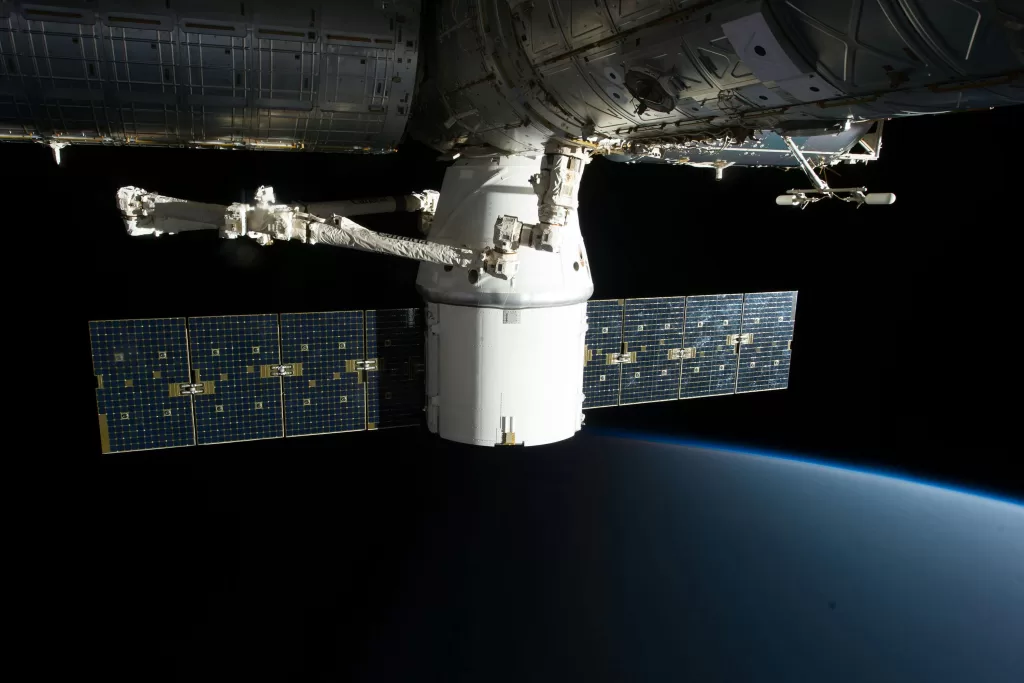
To make a computer survive in space, you usually have to “rad-harden” it. This involves using older, larger manufacturing processes and redundant circuits, which makes the chips slower and vastly more expensive than their terrestrial counterparts. If SpaceX plans to launch standard, commercial-grade NVIDIA GPUs into orbit, they may find them failing at a rate that makes the project unsustainable. And unlike a server farm in Virginia, you cannot just send an IT technician down the aisle with a cart to swap out a fried motherboard. In space, a broken server is just expensive space junk.
We also cannot ignore the speed of light. While it is fast, it is not infinite. Routing data from Earth to a constellation of satellites and back introduces latency. For training a model—where the computer talks to itself for months—this might be acceptable. But for any real-time application or inference, that lag becomes a user experience hurdle that terrestrial fibre optics simply doesn’t have.
It’s Engineering; the Question is What Type
Sceptics might argue that this acquisition has less to do with orbital mechanics and more to do with financial engineering. By folding xAI into SpaceX, Musk is effectively using the massive valuation and capital-raising power of his rocket company to fund the exorbitant burn rate of his AI startup. Training models like Grok requires billions of dollars in hardware and electricity right now, not in three years.
Ultimately, the acquisition of xAI by SpaceX is a bet that engineering brute force can overcome fundamental physics. It posits that the cost of launching mass to orbit will drop so low that we can afford to put disposable, inefficiently cooled data centres in the sky. Until we see a radiator design that defies current thermal dynamics, it is hard to view this as the future of computing. It looks a lot more like a very expensive way to complicate a problem that is much more easily solved on the ground.