

This article was based on an interview with Mr Vincent Caldeira, Chief Technology Officer at Red Hat and Ms Tammy Tan, Country Manager at Red Hat, Malaysia.
Malaysia is making a massive bet.
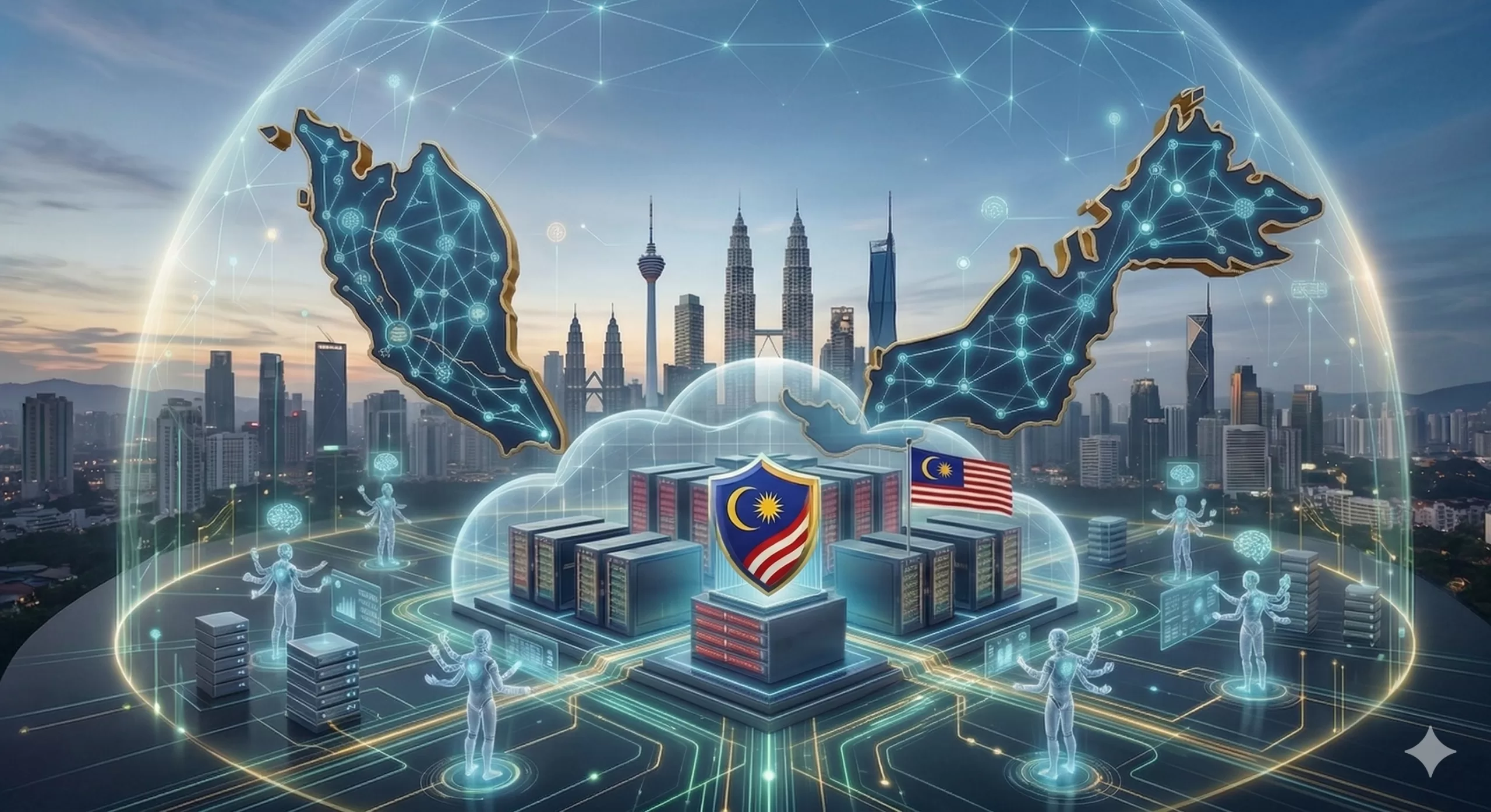
The government is putting RM2 billion into a Sovereign AI Cloud to transition Malaysia from a “Cloud-Taker” to a “Cloud-Maker”. On paper, it sounds like a brilliant press release. But let’s ask the uncomfortable question. Realistically, can a local sovereign cloud actually compete with the feature velocity and massive infrastructure of global hyperscalers like AWS or Google?
The short answer is no. But the long answer is that we don’t need to. In fact, trying to beat them at their own game is missing the entire point of the project.

To separate the political hype from the technical reality, I sat down with Vincent Caldeira, Chief Technology Officer (APAC) at Red Hat, and Tammy Tan, Country Manager of Red Hat Malaysia. They laid out exactly why a Sovereign AI Cloud is less about vanity metrics and entirely about national survival in the next decade of tech.
The Hyperscaler Reality Check
Let’s be direct. A local cloud provider is not going to outspend Google or Amazon.
“While local clouds cannot match the massive expenditure of global hyperscalers and reach the same level of feature parity, they provide essential control over the platform foundations (compute, storage, networking) and ability to operate an AI stack aligned with national requirements, ensuring cultural relevance and linguistic accuracy that foreign models often lack.”
This is the crux of the issue. When we rely entirely on models built in Silicon Valley, we are relying on systems trained on Western data, Western values, and Western nuances. A sovereign cloud isn’t just a regulatory checkbox; it is a strategic move to secure national autonomy. It gives Malaysia the foundational control to build AI that actually understands our local context.
By leveraging open-source technology, Malaysia can bridge this performance gap while maintaining transparency. Ultimately, this protects national security and data residency, while making sure the economic value of AI actually stays inside the country. It is about long-term self-reliance.
The AI Bubble and the API Extortion Threat
There is another, far more immediate danger to Malaysian businesses: the looming “AI Bubble”.
Right now, the global AI market is dangerously centralised. We are seeing aggressive capital expenditure from hyperscalers, and someone eventually has to foot that bill.
“Currently, the situation is that closed models (OpenAI, Anthropic, Google) capture 96% of revenue and 80% of usage of all AI inference revenue… creating a market dominated by a few major players with significant pricing power.”
Think about what that means for a Malaysian SME. If you build your entire business operations around a proprietary API from OpenAI or Google, you are completely at their mercy. If the bubble bursts and they hike their API prices to cover their debts, Malaysian SMEs are directly exposed to aggressive price hikes and technological dependency.
Open-source and sovereign clouds act as an insurance policy. Open models average 87% lower prices than closed-source alternatives.
“By leveraging an AI platform based on open components and open models, businesses can shift from unpredictable per-token fees to stable infrastructure costs, potentially reclaiming up to 70% of their AI spending.”
Avoiding the “Digital Island”
But building a walled garden comes with its own fears. If we build these Sovereign Clouds, are we inadvertently creating a “digital island” where Malaysian agencies and businesses can’t easily integrate with global innovation?
Caldeira argues that true digital sovereignty is built on the principle of “Interoperable Sovereignty”. This ensures local control acts as a catalyst for global trust, rather than a barrier.
By controlling the entire AI stack—the data, the infrastructure, and the models—Malaysia eliminates structural dependencies. But because this effort is built on open-source technology, it relies on consistent technical standards. This interoperability prevents the creation of isolated “digital islands”.
Furthermore, this isn’t about locking businesses into a government-owned basement server. It is about a hybrid cloud approach that grants “Operational Sovereignty”. This allows Malaysian enterprises to choose exactly where to run their workloads—across local and public clouds—without being locked into a single vendor’s ecosystem.
Because it uses open standards and containerization, Malaysian agencies can utilize any hardware accelerator or model format. This means we can still access global innovation, such as the highly efficient open weight models currently coming out of Chinese labs.
Own Your Foundation, Own Your Future
The RM2 billion investment isn’t about building a Malaysian clone of AWS. It is about leverage.
The era of being a passive “Cloud-Taker” is ending. As AI integrates into every facet of our economy, renting our core infrastructure from overseas monopolies is a massive economic and security risk. A Sovereign AI Cloud, powered by open-source, gives Malaysian businesses predictable costs, cultural accuracy, and the operational freedom to run workloads wherever it makes the most sense.
We don’t need to outspend the hyperscalers. We just need to stop being entirely dependent on them.
This article was based on an interview with Mr Vincent Caldeira, Chief Technology Officer at Red Hat and Ms Tammy Tan, Country Manager at Red Hat, Malaysia.
Vincent Caldeira
Chief Technology Officer, Red Hat (APAC)
Vincent Caldeira is Field CTO, APAC at Red Hat. In this role, he is primarily responsible for engaging and building partnerships with strategic customers to explain Red Hat’s vision and establish and reinforce Red Hat as an industry leader while establishing trusted relationships with customers’ technology leaders and advocating for relevant emerging technologies.
Vincent has spent more than 20 years of his career in the financial technology sector, both as a Chief Technology Officer shaping technology strategy, enterprise architecture and driving technology transformation roadmaps, as well as driving talented engineering teams to design, build and deliver software solutions in the financial software vendor industry.
Vincent also contributes to OS-Climate, a Linux Foundation-backed open source project that intends to build the breakthrough technology and data platforms needed to more fully integrate the impacts of climate change in global financial decision-making and risk management, where he acts as the lead architect and Technical Advisory Council member.
Vincent holds a Master of Science in Management (majoring in Information Systems Management) from HEC Paris.

Tammy Tan
Country Manager, Red Hat Malaysia
As country manager, Tammy Tan is responsible for overall sales and business aspects of Red Hat Malaysia. In this role, she leads the country team to drive sustainable growth by building strong and collaborative relationships with enterprise customers, as well as partners.
Tammy joined Red Hat from Cisco Malaysia, where she served as the Director of Enterprise and Commercial. She brings with her 21 years of experience in the IT industry, with deep experience in Financial Services, as well as a broad perspective on vertical solutions within the Energy, Oil and Gas Sector, Transportation, Manufacturing and Hospitality.
Tammy has a passion for STEM and started her career as one of the first female engineers at Siemens and NTT Communications. She holds a degree in Electrical Engineering from the Multimedia University of Malaysia.