
When a highly anticipated, futuristic piece of hardware vanishes from retail shelves just three months after its grand debut, it naturally raises a few eyebrows. Samsung recently confirmed that its incredibly ambitious Galaxy Z TriFold is officially being discontinued. Once current inventories dry up, the company has no plans to restock the device online or in physical stores.

However, rather than viewing this rapid withdrawal as a monumental failure, it is more accurate to view the original TriFold as an expensive, highly public proof-of-concept. As the tech giant closes the chapter on its first three-screen endeavour, the rumour mill is already shifting focus toward a refined sequel and an entirely new slideable form factor slated for 2027.
Closing the Book on the First TriFold
Hitting the market with an astronomical asking price of nearly USD$3000 (about RM12,000), the first-generation Galaxy Z TriFold was never destined for mainstream adoption. Samsung positioned it as a limited-production initiative designed to test the absolute limits of current display technology and gauge actual consumer appetite for a tablet-sized screen that folds neatly into a pocket. The device successfully proved that the underlying engineering was technically feasible and generated massive public interest.
However, hardware feasibility does not automatically equate to commercial viability. The sheer complexity of manufacturing a device with multiple hinges, combined with the rising costs of internal components like memory and storage, simply made the smartphone unsustainable to produce at a larger scale. Rather than struggling to maintain an expensive niche product, Samsung has opted to halt sales early. The company is utilising the massive amount of real-world data gathered during its brief lifespan to completely rethink the underlying architecture for its next iteration.
Refining the Three-Screen Concept
Despite the sudden cancellation of the original model, Samsung is far from abandoning the tri-fold concept entirely. Recent reports from the supply chain indicate that the company is already deep into the feasibility testing phase for a direct sequel, potentially targeting a mid-2027 release window.
The primary goal for this second iteration is to drastically streamline the production process while making the device easier to handle on a daily basis. Initial leaks suggest that the upcoming model will focus heavily on reducing the overall weight, directly addressing one of the biggest ergonomic complaints regarding the first generation. Interestingly, to achieve a simpler, more durable hinge mechanism that is cheaper to mass-produce, the sequel might actually end up being slightly thicker than its predecessor. It is a necessary practical trade-off, prioritising long-term structural integrity and manufacturing efficiency over achieving the absolute thinnest profile possible.
Expanding Horizons With a Slidable Display
Beyond simply adding more hinges to the equation, Samsung is also heavily exploring entirely new ways to expand your mobile real estate. The company is reportedly working on a commercial slideable smartphone, heavily rumoured to debut alongside the TriFold sequel in late 2027 or early 2028. While we have seen early prototypes of rollable displays strictly behind closed doors at trade shows like CES and MWC, this device aims to finally bring the technology to the consumer market in a practical way.
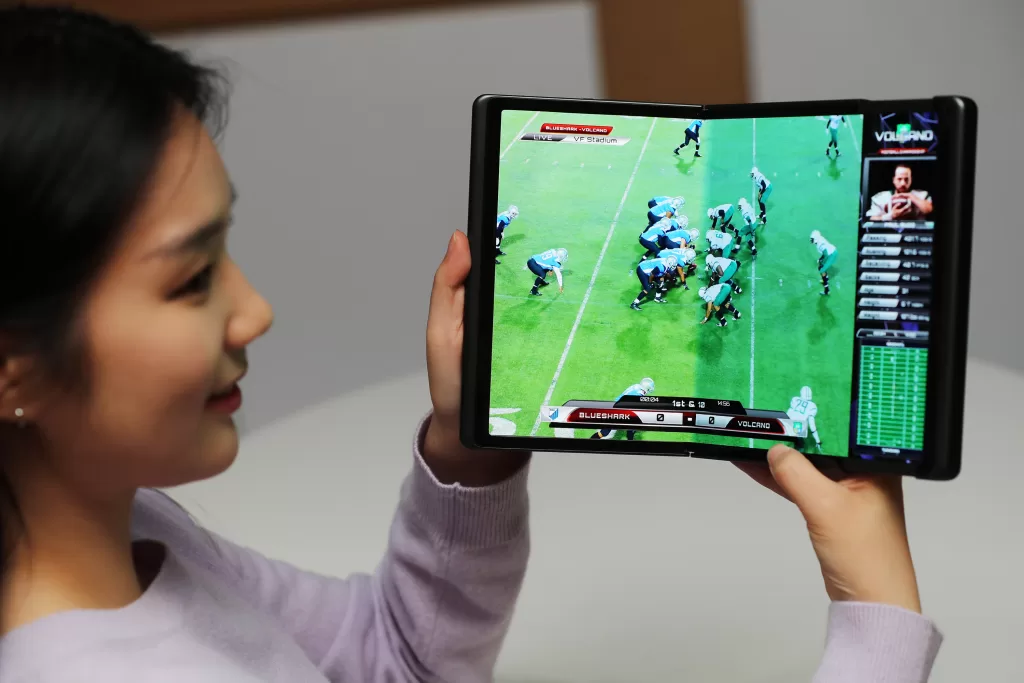
Instead of relying on a highly complex motorised mechanism to unfurl the screen—which often introduces massive battery drain and long-term durability concerns—this upcoming device will reportedly utilise a manual sliding motion. Users will be able to physically expand the display outward to roughly seven inches whenever they need a larger canvas for multitasking or media consumption. By eliminating the internal motors, Samsung hopes to deliver a slideable device that is significantly thinner and structurally more stable than early experimental units, offering a practical alternative to the traditional foldable notebook design.
The Future of Expanding Screens
The rapid discontinuation of the original Galaxy Z TriFold highlights the harsh realities of pushing cutting-edge hardware to the consumer market before the manufacturing processes have fully matured. It was an ambitious, flawed, and incredibly fascinating glimpse into the future of mobile computing. As we look ahead to 2027, the focus is clearly shifting away from expensive novelty and toward practical refinement. Whether you prefer the book-like expansion of a refined tri-fold or the smooth, horizontal action of a slideable display, Samsung is heavily betting that the traditional slab smartphone is just the starting point for your daily workflow.