
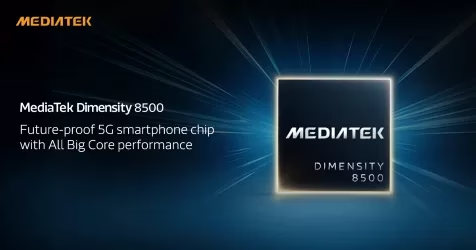
While the headlines are often dominated by the absolute bleeding edge of technology, the real battle for the hearts and pockets of consumers is fought in the premium segment. This is where the price-to-performance ratio matters most, and MediaTek’s latest announcement of the Dimensity 8500 aims to redefine what we can expect from a sub-flagship smartphone. Launching alongside its big brother, the Dimensity 9500s, the 8500 is arguably the more interesting chip for the average Malaysian user because it promises to bring top-tier features to devices that won’t require a second mortgage to purchase.
The All Big Core Philosophy Trickles Down
The standout feature of the Dimensity 8500 is its adoption of MediaTek’s “All Big Core” CPU architecture. Typically, mobile processors use a mix of big, powerful cores for heavy tasks and smaller, weaker cores for background tasks to save battery. With the 8500, MediaTek has opted for a configuration of eight Cortex-A725 cores, all capable of ramping up to a frequency of 3.4GHz.
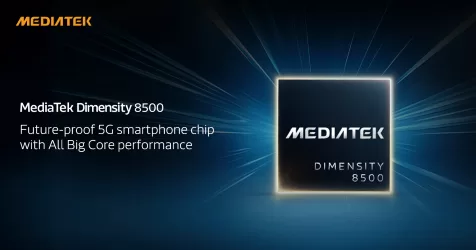
This approach is significant because it removes the ramp-up lag often felt when switching between light and heavy applications. By using eight capable performance cores built on an energy-efficient 4nm process, the chipset can handle sustained multitasking and heavy workloads without the stutter that sometimes plagues mid-range chips. It effectively raises the floor of performance, ensuring that your daily experience—from scrolling through social feeds to editing a 4K video—feels consistently smooth and responsive.
Gaming with Ray Tracing for the Masses
Mobile gaming is no longer just about crushing candy; it is about exploring open worlds and competing in high-fidelity arenas. The Dimensity 8500 addresses this with an integrated Mali-G720 GPU. According to MediaTek, this new graphics engine delivers a peak performance improvement of 25% compared to its predecessor, while simultaneously slashing power consumption by 20%.
What makes this truly exciting for gamers is the inclusion of ray tracing technology for mainstream mobile games. Ray tracing mimics how light behaves in the real world, creating realistic reflections and shadows. Previously reserved for the most expensive devices, the Dimensity 8500 brings this immersive visual fidelity to a wider audience. Combined with support for fast LPDDR5X memory (clocking in at 9600Mbps), games are expected to load rapidly and maintain frame stability even during chaotic in-game moments.
AI and Imaging Intelligence
We are living in the age of Artificial Intelligence, and the Dimensity 8500 ensures that premium devices aren’t left out of the revolution. The chipset houses MediaTek’s 8th-generation NPU (Neural Processing Unit), which is robust enough to support global mainstream Large Language Models (LLMs) and image generation models directly on the device. This means features like summarizing a long meeting recording or generating a unique wallpaper can happen locally on your phone, offering better privacy and speed than cloud-based alternatives.
This AI prowess extends heavily into photography. The chipset features a dedicated Dimensity AI semantic engine that intelligently optimizes image content frame by frame. It identifies different elements in a shot—like the sky, faces, or buildings—and tunes them individually for the best result. Furthermore, MediaTek has included an AI ultra-clear telephoto algorithm. This is particularly practical for users who love taking zoomed shots at concerts or events, as it uses software smarts to clean up the noise and blur that usually ruins digital zoom photos.
When Will We See the First Devices?
With the chipset officially unveiled in mid-January 2026, the timeline for actual devices to hit store shelves is relatively short. Smartphone manufacturers usually work in tandem with silicon providers well before the public announcement. Consequently, we anticipate the first wave of smartphones powered by the Dimensity 8500 to emerge towards the end of the first quarter of 2026. It is highly likely that brands like Xiaomi, OPPO, and vivo will debut these devices around the time of Mobile World Congress in late February, with local Malaysian availability following closely in March or April. If you are planning to upgrade your phone this year, it might be worth waiting a few months to see what this new “premium killer” silicon brings to the table.