

For years, the conversation around childhood myopia, known colloquially as nearsightedness, has been dominated by a simple, albeit incomplete, solution: putting on a pair of glasses to see the whiteboard. While this corrects vision, it does nothing to stop the underlying physiological issue, the physical elongation of the eyeball. As the eye grows longer, the risk of severe ocular pathologies later in life, such as retinal detachment and glaucoma, increases exponentially.
HOYA has been tackling this with their MiYOSMART lenses powered by D.I.M.S. (Defocus Incorporated Multiple Segments) technology. While global data has been promising, local context is crucial in medical science. Genetics, environment, and even retinal pigmentation can influence how effective a treatment is.

In conjunction with their recent “A Million Visions” campaign, HOYA Malaysia released the findings of a landmark clinical study conducted by Universiti Kebangsaan Malaysia (UKM). The study, titled “Effectiveness of Defocus Incorporated Multiple Segments (DIMS) Lens in Slowing Myopia Progression among Malay Schoolchildren,” provides the first clinically verified local data on how this technology performs on our home ground. The results are statistically significant: the technology doesn’t just correct vision; it fundamentally alters the progression of eye growth.
The Technology: How D.I.M.S. Halts Eye Growth
To understand the significance of the study, we first need to look at the engineering inside the lens. Standard single-vision lenses—the kind most of us grew up wearing—have a singular focus point. They correct the refractive error by focusing light directly onto the retina. However, due to the curvature of the eye, these standard lenses can create a phenomenon known as “hyperopic defocus” at the peripheral retina, where light focuses behind the retina. This defocus essentially signals the eye to elongate to “catch” the light, inadvertently accelerating myopia progression.

D.I.M.S. technology fundamentally changes this optical input. The lens features a central optical zone of 9mm for clear, sharp vision Surrounding this centre is a honeycomb-like structure comprised of multiple “lenslets,” each with a relative positive power of +3.50D.
These lenslets create “simultaneous myopic defocus,” focusing peripheral light in front of the retina. This creates a stop signal for the eye, effectively inhibiting axial elongation while maintaining clear central vision.
The UKM Study: Validating Efficacy for Malay Children
Previous studies on D.I.M.S. technology heavily featured East Asian cohorts, particularly from Hong Kong. The UKM study is significant because it targeted myopic Malay schoolchildren to determine if ethnicity and retinal profile differences impacted efficacy.
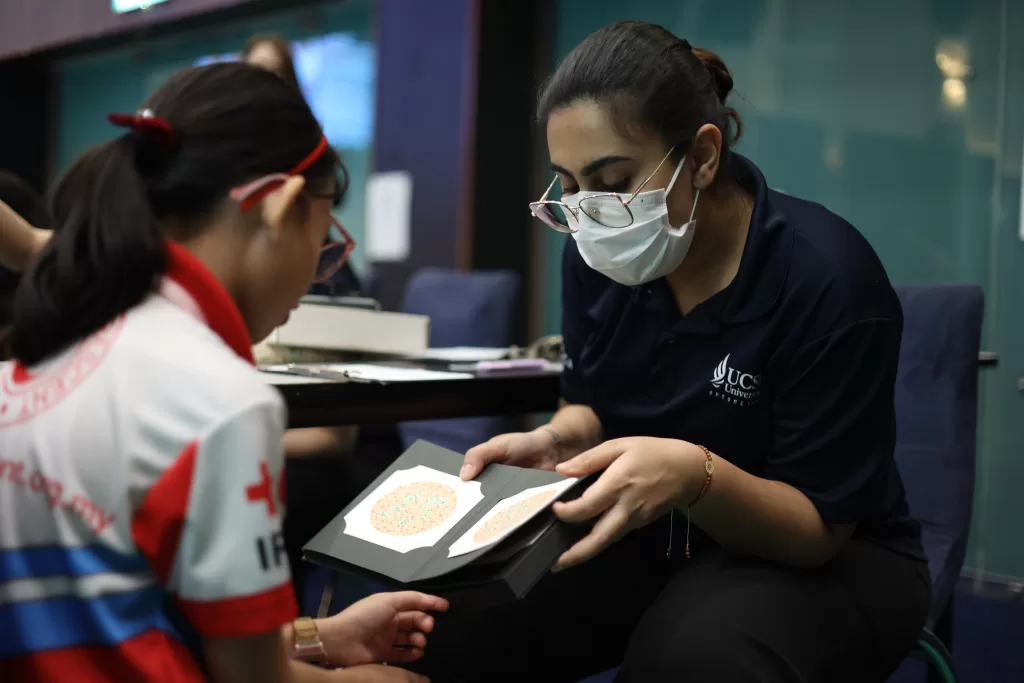
The research was conducted as a prospective, randomised, double-masked clinical trial—the gold standard for clinical evidence. Forty-two children aged 7 to 12 were recruited and randomly assigned either the D.I.M.S. lens or a standard single-vision (SV) lens. Researchers tracked them over 12 months, measuring two critical metrics: Spherical Equivalent Refraction (SER), which is the prescription power, and Axial Length, the physical length of the eye.
The findings after one year were compelling. The study found that the children wearing standard lenses experienced typical myopic progression, with their prescription worsening by an average of -0.44D12. In stark contrast, children wearing the D.I.M.S. lenses saw a progression of only -0.16D13. This represents a 63.6% reduction in refractive change.
More importantly, the study measured the physical growth of the eye. In the control group (standard lenses), the axial length grew by 0.20mm. In the D.I.M.S. group, the eye grew by just 0.07mm. This translates to a 65% reduction in axial elongation.
Why does this 0.13mm difference matter? In the world of ophthalmology, axial length is the gold standard for monitoring myopia. Keeping the eye shorter is the only way to reduce the long-term risk of myopia-associated pathologies.
Usability and Visual Performance
A common hurdle in pediatric medical technology is compliance—the best tech in the world is useless if a child refuses to use it. The UKM study closely monitored how the children adapted to the complex lens structure.
The data showed no significant difference in wearing time between the two groups. Children in the D.I.M.S. group wore their glasses for an average of 15.85 hours per day, compared to 15.94 hours for the control group. This high compliance rate suggests that the “honeycomb” structure of the lenslets does not negatively impact daily activities or comfort.
Furthermore, researchers measured visual acuity (sharpness) and contrast sensitivity. The study found that children wearing the D.I.M.S. lenses achieved the same level of visual clarity (Best Corrected Visual Acuity) as those wearing standard lenses. There was no trade-off between treating the condition and seeing clearly in the classroom.
Study Validates Similar Studies, But Needs Larger Population Studies for Greater Impact
The UKM study serves as a critical validation piece for the Malaysian market. It confirms that the mechanism of myopic defocus is effective regardless of the specific pigmentary or genetic differences between East Asian and Malay populations. However, it’s worth noting that the size of the research sample is small, only consisting 42 participants in a single site. It requires a larger research population and more sites for better quality data.
That said, for r the tech-forward parent, this represents a shift in how we manage eye health. We are moving away from passive correction (simply making the image clear) to active control (altering the physiological growth of the organ). With a confirmed 65% reduction in progression in a local clinical setting, D.I.M.S. technology has graduated from a theoretical solution to a verified medical intervention for Malaysian children.