

Takeaways from the recent Zenith Live 26 (Vienna) Keynote
There is an undeniable inertia in the cybersecurity industry. For decades, organisations have thrown millions of dollars at building bigger moats, thicker walls, and more complex perimeter defences. Yet, breaches keep rising. At Zscaler’s Zenith Live 2026 conference in Vienna, the message from the main stage was loud and clear: traditional network security architecture isn’t just failing; it’s completely obsolete.
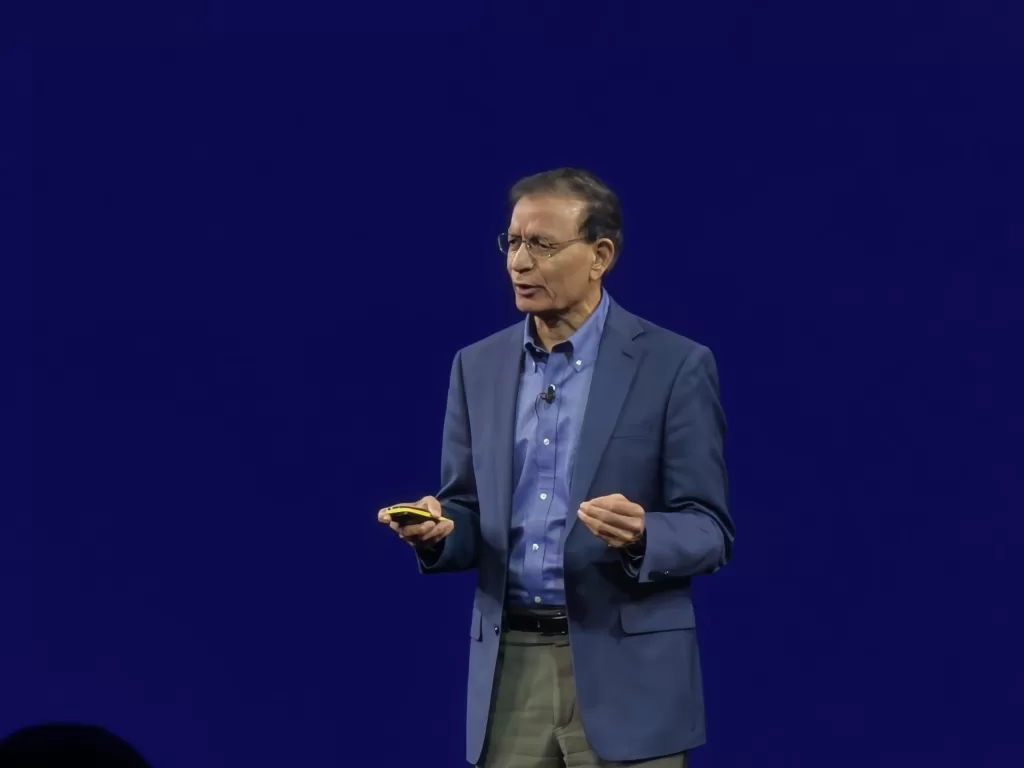
When Zscaler CEO Jay Chaudhry took the stage, he didn’t just talk about incremental updates. He re-evaluated the fundamental way we think about connectivity. In a world defined by hypermobility, cloud workloads, and now the explosive rise of autonomous AI agents, trying to secure a network perimeter is akin to trying to put a fence around the ocean.

Here are the key takeaways from Chaudhry’s opening keynote, charting the course for a post-firewall future.
1. Shaking Off Network Inertia: The Shift from Bridges to Switchboards
The biggest hurdle to modern enterprise security isn’t tech—it’s mindset. Organisations are comfortable with what they know, clinging to traditional firewalls and VPNs because they’ve used them for twenty years. But as Chaudhry pointed out, technology undergoes step-function changes every decade, and network security is long overdue for its own evolution.
The fundamental flaw of the traditional approach is that it connects networks together. A firewall acts like a bridge; once that bridge lowers, traffic flows across it. If a bad actor gains access to that network, they can move laterally to find applications and data. Zero Trust, by contrast, operates like an old-school switchboard. It connects a user to an application, or entity to entity, without ever placing them on the underlying network.
“A firewall is like a bridge… And once the bridge opens up, the traffic starts flowing. Good things can flow, and bad things can flow as well. Contrast that with the Zero Trust architecture, which is like a switchboard where every connection comes to the switchboard. It gets examined for policy, and then you get connected to a specific application or resource, not to the network.”
— Jay Chaudhry, CEO, Zscaler
By decoupling security from IP addresses and routing tables, enterprises can completely eliminate the concept of private corporate networks, turning the public internet into their secure cyber highway.
2. Going Dark: Hiding the Attack Surface to Defeat Advanced Vulnerabilities
The traditional approach to security relies heavily on a never-ending game of whack-a-mole: discovering vulnerabilities and rushing to patch them. With advanced AI models now being used by adversaries to find security holes at an unprecedented pace, the traditional patching lifecycle is entirely overwhelmed.
The remedy isn’t faster patching; it’s total invisibility. If a branch office, manufacturing plant, or IoT utility cannot be discovered on the internet, it cannot be targeted. During the keynote, Kurt De Ruwe, CIO at AkzoNobel, shared how the global paints and coatings giant successfully implemented an internet-only model across nearly 1,000 connected sites, removing traditional SD-WAN and branch firewalls entirely.
“With zero trust, you can add all kinds of layers. I think with Zscaler, we’re eliminating layers. We’re eliminating basically complexity… Every branch goes dark and cannot be discovered from the internet.”
— Jay Chaudhry, CEO, Zscaler
When an enterprise site “goes dark,” it no longer advertises its presence to the world with a public-facing firewall saying, “Come try to break me.” It becomes an isolated island, completely hidden from external scans.
3. Securing the Invisible Grid: Micro-Segmenting the Factory Floor (OT)
For years, Operational Technology (OT) and critical manufacturing environments were kept safe through air-gapping. But the modern push for industrial digitisation has bridged the gap between IT and OT, creating massive security risks. If a single ransomware strain penetrates a corporate network, it can quickly crawl onto the factory floor, halting assembly lines and disrupting critical supply chains.
Dr Stefan Henkel, CIO of Siemens Healthineers, underscored the severe real-world stakes of this reality during his onstage appearance, citing recent high-profile healthcare infrastructure attacks that cost nearly a billion dollars in damages and put human lives at risk. The solution lies in aggressive micro-segmentation down to the cellular level on the factory floor.
“The next big, let’s say, change management field is the OT environment… We want to use the branch connector really to drive also there more security by connecting the different cells in a factory, not just each factory, and drive it forward because we believe that at a certain point in time, there will be an incident. And the better we have micro-segmented our factories, the better we are.”
— Dr. Stefan Henkel, CIO, Siemens Healthineers
By shifting to an architecture where PLCs, manufacturing cells, and critical medical systems require precise, identity-based authorisation to talk to one another, industrial giants can ensure that an infection in one corner of the business stays entirely contained.
4. The New Weakest Link: Shifting Focus from Human Users to AI Agents
Perhaps the most disruptive shift highlighted during the keynote is the transition of the workforce itself. For decades, security teams treated human users as the weakest link in the defence chain—susceptible to phishing, social engineering, and password reuse. Today, the balance of risk is shifting toward autonomous AI agents.
These digital workers act independently, creating code, executing operations, and interacting with core data structures at machine speed without human intervention. Traditional security protocols, built to monitor human behaviour through screens and keystrokes, completely break down when confronted with autonomous software entities that require no sleep and execute tasks in milliseconds.
“Yesterday, a user was the weakest link. Today, these agents are becoming the weakest. In fact, they are far more dangerous than human beings because they move at machine speed. They need no coffee break, no weekends, no time to sleep, and the number keeps on going at a rapid pace.”
— Jay Chaudhry, CEO, Zscaler
To scale securely in this environment, Zero Trust principles must expand beyond human users and cloud workloads to encompass the entire agent ecosystem. Securing this digital workforce will define the next decade of enterprise resilience.
Shaking Off the Inertia
To boil it down, the core takeaway from the opening of Zenith Live 2026 is an urgent call to action for technology leaders. The rapid adoption of cloud computing, decentralised supply chains, and autonomous AI infrastructure means that the old ways of networking and security are dead weight. Survival in this new landscape requires organisations to shake off the inertia of legacy systems, abandon the perimeter mindset, and build an architecture grounded in absolute, verified Zero Trust.