
Data management has always suffered from a lingering, hidden tax: fragmentation. Historically, organisations scaling up their analytics or AI pipelines have had to grapple with an inefficient cycle of copying, stitching, and duplicating data across separate cloud environments just to make it usable. It is a slow, expensive process that creates inconsistent baselines and introduces massive structural friction. At Snowflake Summit 26 in San Francisco, the data cloud giant made a direct, highly utilitarian play to end this operational overhead by rolling out an open framework entirely built around universal interoperability.
The central thesis behind this shift is simple: enable enterprise teams and autonomous AI agents to work from a single, live, governed copy of data wherever it resides, without moving or duplicating it. By leveraging the Snowflake Horizon Catalog, organizations can transform siloed environments into a connected, AI-ready foundation.
Dismantling Lock-In with Apache Iceberg v3 and Polaris
The engineering foundation of this shift relies heavily on open-source table architecture. Snowflake has announced the general availability of support for Apache Iceberg v3, providing a fully managed storage environment for massive analytic tables.
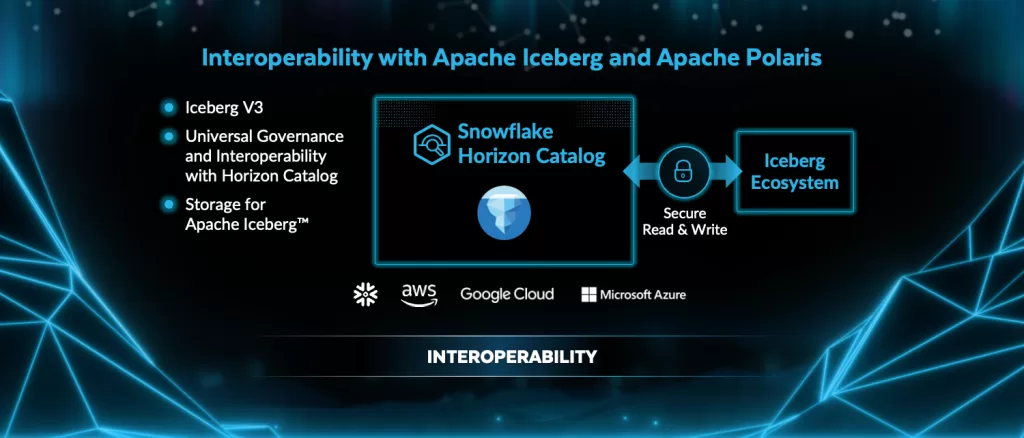
What this means in daily practice is a massive performance optimization for mixed, data-heavy workloads:
- Cross-System Change Tracking: Makes incremental data processing exceptionally efficient across diverse clouds.
- Semi-Structured Optimization: Delivers much faster, high-performance querying on complex, non-traditional data types.
- Bi-Directional Access: Powered by Apache Polaris, an open-source data catalog, the ecosystem allows external computing engines to read and write directly to Snowflake-managed Iceberg data.
By embracing standards defined entirely by the open-source community, organisations gain the flexible control to choose different processing engines for specific workloads without worrying about proprietary vendor lock-in or duplicate compute infrastructure costs. Major brands like Affirm have already proven this configuration at scale, migrating thousands of tables and critical financial workloads to Polaris with zero downtime.
Driving Workflows with Zero-Copy Integrations
For engineering teams, the absolute highlight of this open structure is the arrival of Zero-Copy Integrations with cornerstone enterprise platforms like SAP, Salesforce, and Workday.
Instead of orchestrating complex custom pipelines to sync data across platforms, engineers can activate live data lakehouses without replication. To make this even more practical for daily workflows, Snowflake’s AI coding agent, Snowflake CoCo, now features a dedicated Skill for SAP. Developers can use natural language prompts inside their existing environments to connect to, explore, and manage complex SAP data schemas effortlessly.
This openness directly changes how data assets are shared and consumed. Providers on the Snowflake Marketplace can instantly convert a secure data listing into a conversational agent using Auto-gen Agents for Data Shares. Global companies like Indeed are using these interoperable frameworks to slash unnecessary data movement while accelerating how quickly they deploy new AI-driven capabilities. Consumers can ask questions in plain text, blend external information with their first-party data sets, and get enterprise governance out of the box.
Universal Governance Across Multi-Engine Landscapes
When data becomes highly distributed across multiple clouds and external lakehouses, maintaining a robust security posture is notoriously difficult. Traditional access controls were built for human users, not autonomous AI systems capable of independently querying sensitive data.
Snowflake is bridging this gap by using the Snowflake Horizon Catalog as a centralized, metadata-driven control plane. Through support for the open Iceberg REST Scan Plan API, data protection policies—like fine-grained column masking and row-level access controls—are consistently enforced across all compatible engines. Security teams can define a policy once, and it dynamically applies everywhere data is accessed.
Furthermore, with Connected Audit Access and new observability features, administrators gain a centralized view into data access paths and pipeline health across external environments, helping teams proactively troubleshoot issues faster.