
Enterprise AI has spent a lot of time in the headlines lately, but truth be told, most projects suffer from a massive bottleneck: trust. Spinning up a temporary proof-of-concept chatbot is easy enough, but letting an autonomous AI agent loose on your actual production data is a completely different story. If your corporate data definitions are fragmented across isolated systems, a bot will guess, hallucinate, or make critical operational mistakes.
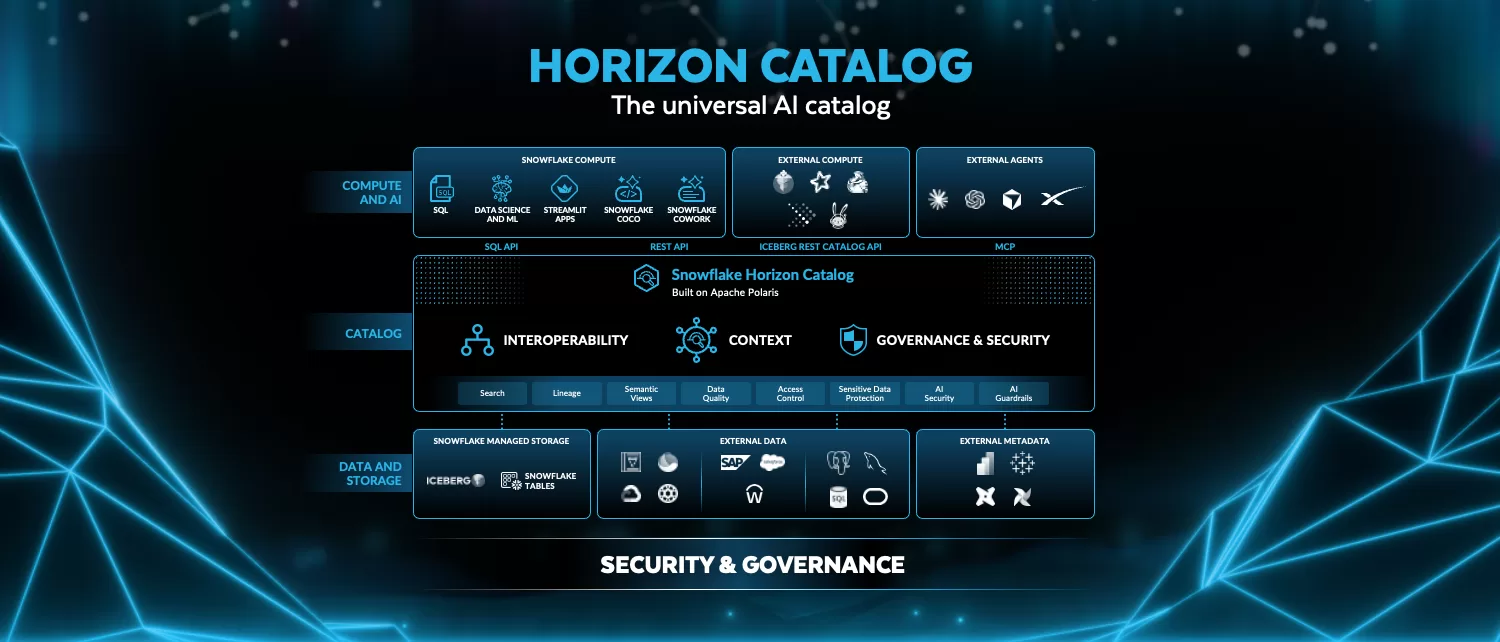
At Snowflake Summit 26 on June 2, 2026, Snowflake addressed this hurdle head-on by introducing major new innovations across the Snowflake Horizon Catalog. Positioned as a universal AI catalogue for enterprise data, this platform completely redefines how organisations govern, contextualise, and secure AI workloads at scale. It acts as a unified control plane, ensuring that every person, application, and autonomous agent draws from a single, uncompromised version of corporate truth.

Grounding AI in a Shared Reality
The biggest reason corporate AI projects stall out between development and deployment is data inconsistency. Traditional semantic layers exist entirely separate from the underlying data. For example, if a data database defines “revenue” one way and a sales dashboard calculates it another, an AI agent tasked with optimising prices will inevitably make misinformed decisions.
Snowflake is solving this exact problem with Horizon Context, a dedicated shared layer built to unify business definitions across an organisation’s entire data estate, including traditional databases, data lakes, and business intelligence (BI) tools.
For modern knowledge workers and data teams, this has massive practical implications for daily workflow management:
- Semantic Studio: Data teams can define shared business logic naturally without needing complex SQL expertise or advanced engineering scripts.
- Semantic View Autopilot: This system automatically creates and refines semantic views over time, ensuring definitions stay completely accurate as data evolves.
- Snowflake Marketplace Integration: These semantic rules automatically attach to third-party datasets shared across organisations, keeping context completely intact.
What this means for everyday operations is total consistency. If you ask a coding agent like Snowflake CoCo an intricate financial question, it doesn’t just guess based on raw numbers; it interprets the shared business definitions to deliver a reliable, accurate response. Global financial institutions like BlackRock are already leveraging this context layer to ensure their autonomous apps stay safely anchored to corporate truth.
Zero-Trust Security for the Bot Era
Beyond data context, scaling enterprise AI presents a massive security barrier. Access control models were originally engineered to monitor human employees, not autonomous AI agents capable of moving across networks, reading sensitive files, and executing workflows independently. When an agent acts on its own, traditional permissions completely fall apart.
To address this vulnerability, Snowflake is introducing a zero-trust architecture purpose-built for independent actors. The standout feature here is Agent Identity, which assigns a fully verified digital identity to every autonomous agent before it can interact with corporate systems. The catalogue strictly enforces role-based permissions and maintains an absolute, immutable audit trail of every bot action, neutralising data exfiltration risks and ransomware threats.
Furthermore, security administrators can track these system behaviours continuously via the Snowflake Trust Center. It features AI-guided, context-aware assistance to help security teams investigate violations and mitigate emerging risks at machine speed, completely bypassing the crippling alert fatigue that usually plagues enterprise operations. Mainstream organisations like Acxiom, NewDay, and Thomson Reuters are already utilising these frameworks to securely bridge the gap between AI innovation and data compliance.
Stripping Away Complexity with Adaptive Compute
Data governance and zero-trust security are frequently viewed as architectural roadblocks that introduce operational friction and slow down development. AI introduces highly dynamic, unpredictable computing workloads that make resource management incredibly difficult to balance manually.
Snowflake is smoothing this over with Adaptive Compute. Operating entirely behind the scenes with the Horizon Catalog, it automatically calculates and optimises the perfect mix of hardware and software resources in real-time. It removes the need for manual server tuning or infrastructure babysitting, delivering a true serverless experience.
By tying unified context, bot-level security, and automated compute scaling into one connected foundation, Snowflake is making data trust an invisible default rather than a late-stage headache. It is a direct, unbiased, and highly utilitarian upgrade that sets a new baseline for the agentic enterprise.