

We have spent the last few years watching companies pour billions into training AI models—feeding them data until they get smart. But at CES 2026, Lenovo signalled that the industry is finally shifting gears. The focus is no longer just about building the smartest model; it is about putting that model to work. This process is called “inferencing,” and it is where the actual business value of AI happens. To support this shift, Lenovo has rolled out a new suite of ThinkSystem and ThinkEdge servers designed specifically to handle these real-time workloads without melting down your data center.
Lenovo ThinkSystem SR675i: The Heavy Lifter
At the top of the food chain sits the ThinkSystem SR675i. If you are running massive Large Language Models (LLMs) or complex simulations in finance or healthcare, this is the machine you are looking at. It is built for raw density and scale. Under the hood, it supports dual AMD EPYC 9005 series processors and can house up to eight NVIDIA RTX 6000 Blackwell GPUs. This configuration isn’t just for show; it allows the server to process full-scale parameter models locally, which is critical for industries that cannot afford the latency of sending data back and forth to a distant cloud.
The SR675i also addresses the thermal elephant in the room. High-performance inference generates immense heat, and to manage this, Lenovo has integrated its Neptune cooling technology. This liquid-to-air hybrid system keeps the GPUs running at peak efficiency without requiring a complete overhaul of your existing air-cooled data center infrastructure.
Lenovo ThinkSystem SR650i: The Versatile Workhorse
For businesses that need scalability but might not require the extreme density of the SR675i, the ThinkSystem SR650i offers a more balanced approach. This 2U server is designed to slot easily into standard rack setups while still delivering significant inferencing power. It runs on dual Intel Xeon 6 processors and supports high-density GPU configurations, capable of fitting up to four double-wide or eight single-wide GPUs.
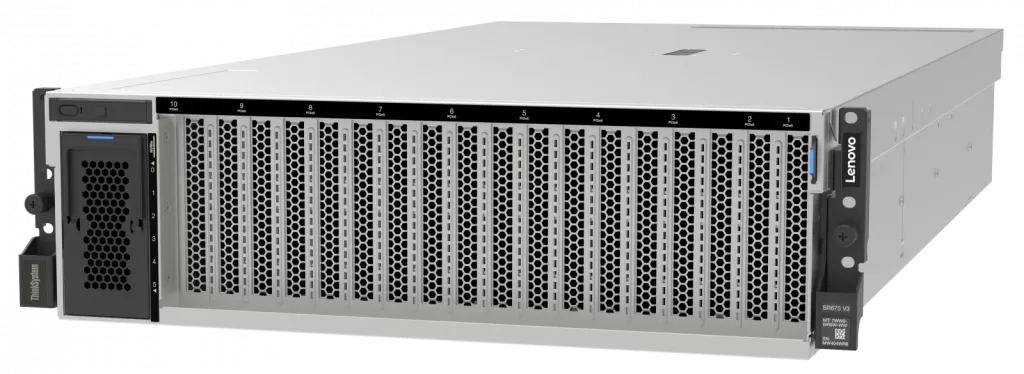
The practical appeal of the SR650i lies in its storage and memory bandwidth. It supports PCIe Gen5 and high-speed NVMe storage, ensuring that the bottleneck isn’t the drive speed when the GPU is trying to crunch data. It is effectively a “Swiss Army Knife” for enterprise AI, flexible enough to handle computer vision in a factory or predictive analytics in a retail back office.
Lenovo ThinkEdge SE455i: AI in the Wild
Perhaps the most interesting device in the lineup is the ThinkEdge SE455i. Unlike its data center siblings, this server is designed to live “at the edge”—meaning in telecommunications towers, dusty retail backrooms, or manufacturing floors. It features a short-depth chassis that fits into shallow cabinets and is built to withstand environments that would kill a standard server. It is rated to operate in temperatures ranging from -5°C to 55°C, making it incredibly resilient.
Despite its rugged nature, it doesn’t skimp on performance. Powered by a single AMD EPYC 8004 processor, it can support up to six single-width GPUs. This allows businesses to run AI workloads like real-time video analytics or natural language processing right where the data is collected, rather than waiting for it to travel to a central hub. It is specifically tuned for ultra-low latency, which is non-negotiable for applications like automated quality control or autonomous retail systems.
The Software Ecosystem: Hybrid AI Factory
Hardware is only half the equation. To ensure these boxes actually deliver value, Lenovo has partnered with major software players to create verified stacks under its “Hybrid AI Factory” initiative.
- Nutanix AI: Focuses on virtualization, allowing for maximum GPU utilization and simpler management.
- Red Hat AI: Provides an enterprise-grade platform for those who need strict security and flexibility for complex workloads.
- Canonical Ubuntu Pro: Offers a cost-effective, streamlined entry point for businesses looking to experiment and deploy rapidly without heavy licensing overhead.
Bridging the Gap Between Training and Action
The narrative of the last two years has been dominated by the arms race to build the biggest, smartest models, but Lenovo’s latest portfolio acknowledges that the industry’s focus has fundamentally shifted. We are moving away from the capital-intensive phase of training massive datasets towards the operational reality of inferencing, where the goal is immediate, actionable insight. By diversifying its hardware to cover every possible deployment scenario—from the liquid-cooled intensity of the SR675i in the data center to the rugged utility of the SE455i at the edge—Lenovo is effectively providing the infrastructure required to turn AI from a science experiment into a business utility. This portfolio directly addresses the market’s growing impatience for return on investment, ensuring that enterprises have the specific tools needed to deploy their models exactly where the work is being done, rather than forcing every task back to a central cloud.