


When it comes to upgrading your home network, the choices have traditionally been abundant and highly competitive. However, a major regulatory shift is about to severely constrain your options. The Federal Communications Commission has officially updated its Covered List, taking the unprecedented step of effectively banning the import and sale of all new consumer-grade Wi-Fi routers manufactured outside the United States.
Redefining the Covered List
The scope of this decision is massive. The Covered List is a running roster of communications equipment that the federal government considers an unacceptable risk to national security. In the past, this list specifically targeted individual companies tied to foreign adversaries. Now, following a sweeping National Security Determination by an executive branch interagency body, the restriction applies globally. It dictates that any new router designed, developed, or assembled outside of American borders is strictly prohibited from receiving the FCC authorisation required to hit retail shelves.
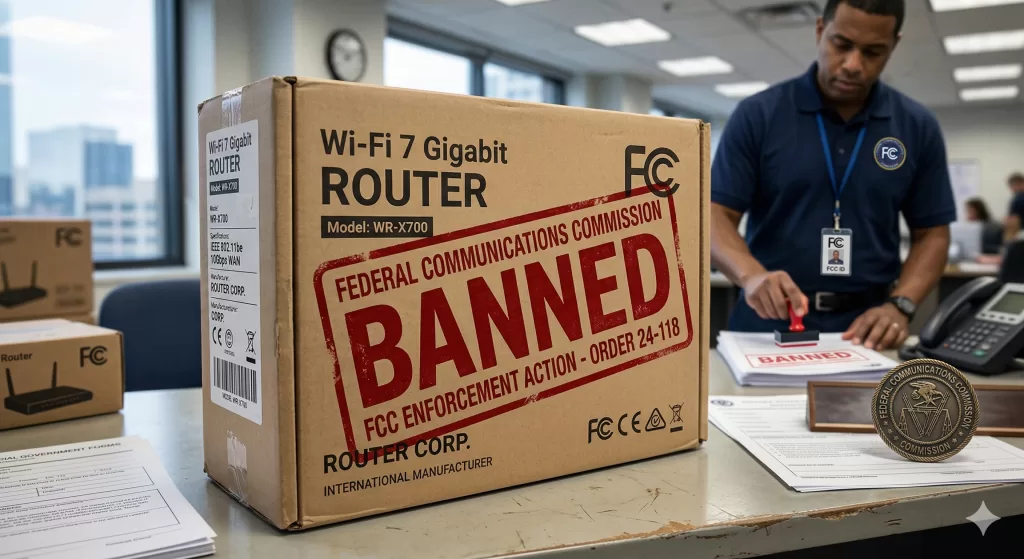
This ruling aggressively disrupts an entire industry because router manufacturing is an inherently globalised process. Even the most recognisable American networking brands, such as Netgear, Amazon’s Eero, and Ubiquiti, rely heavily on production facilities located in Taiwan, Vietnam, and China. Under the new rules, simply being headquartered in the United States is no longer enough. If the physical hardware is built overseas, the device is banned from receiving new market authorisation.
Why? Cybersecurity.
The justification behind this aggressive market intervention centers squarely on cybersecurity and protecting critical infrastructure. The Federal Communications Commission points to recent, highly sophisticated cyberespionage campaigns, notably the Volt, Flax, and Salt Typhoon attacks, as the primary catalysts.
In these instances, state-sponsored hackers actively exploited vulnerabilities in consumer-grade routers to establish massive botnets and infiltrate sensitive American networks. By mandating a domestic supply chain, the government aims to eliminate the risk of foreign actors slipping built-in backdoors or malicious code into the hardware that powers our homes, businesses, and emergency services.
What This Means for Your Existing Hardware
For the everyday consumer, the immediate impact is a mix of relief and impending frustration. The most crucial detail is that the ban is not retroactive. If you currently own a foreign-made router, you do not need to unplug it or throw it away. You are legally allowed to continue using your existing hardware.
Furthermore, retailers can continue selling any router models that already received their FCC authorisation prior to the ruling. The government has also granted a limited waiver, ensuring that these existing devices can continue receiving vital security patches and firmware updates until at least March of 2027, giving consumers a reasonable buffer period before their current hardware becomes completely obsolete.
The Future of Upgrades and Market Pricing
However, the long-term practical implications are far less consumer-friendly. Because nearly every router on the market today is produced overseas, the pipeline of new, next-generation networking hardware is effectively frozen. If you are planning to upgrade to the latest Wi-Fi 7 technology or a high-end mesh system in the near future, your choices are about to become incredibly limited. As existing inventory inevitably dries up, consumers should brace for significant price hikes. Retailers and manufacturers will likely adjust their pricing to offset the sudden scarcity of available hardware.
For manufacturers looking to introduce new products, the only pathway forward is incredibly steep. Companies can apply for Conditional Approval through the Department of Homeland Security or the Department of Defense. This process requires absolute corporate transparency, a complete breakdown of every single internal component’s origin, and a strict, time-bound commitment to physically move their manufacturing operations onto United States soil within a designated timeframe. Relocating complex electronic assembly lines and reestablishing semiconductor supply chains is a massively expensive and time-consuming endeavor. While some premium brands may absorb the massive cost of domestic production, many budget-friendly manufacturers may simply choose to exit the American market entirely.